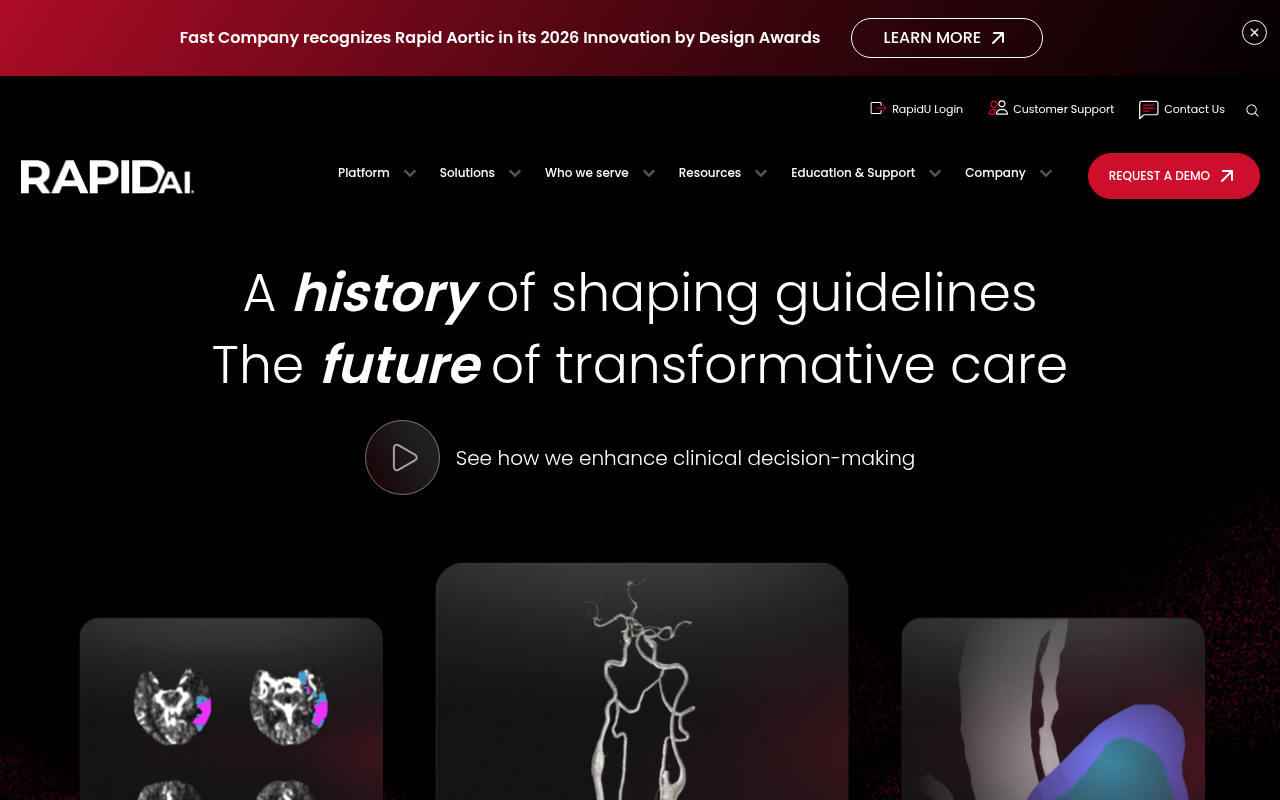
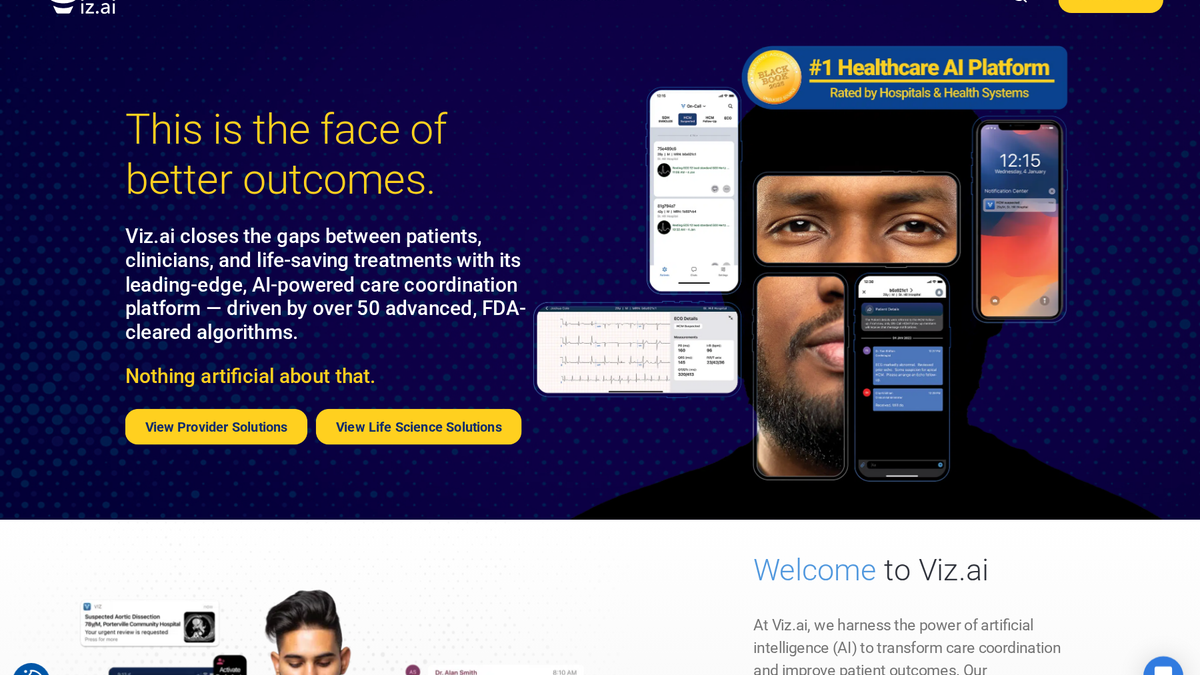
Stroke centers and hospital networks buying stroke imaging software often compare RapidAI and Viz.ai. Both read brain scans for signs of a stroke, such as a large vessel occlusion, which is a blocked major artery in the brain, and send the results to the stroke team's phones. RapidAI grew out of stroke imaging work at Stanford University, and its perfusion maps, which show how much brain tissue can still be saved, were used to choose patients in the DAWN and DEFUSE 3 trials. Viz.ai, founded in 2016, received the first FDA clearance for software that flags a suspected stroke and alerts the specialist, and it built its product around coordinating the care team after that alert.
RapidAI
8.1Overall
Recommend
Best for
Stroke centers and health systems that select patients for clot removal using CT perfusion and CT angiography
Watch-out
Small hospitals that only need a basic alert for a blocked brain artery
Viz.ai
7.7Overall
Recommend
Best for
Stroke and other emergency care teams where the minutes between the scan and the specialist matter most
Watch-out
Hospitals that only want an algorithm to read images and have no use for care-team alerts and messaging
How they differ
Axis
RapidAI
Viz.ai
Reading the scans for treatment decisions
✓Stronger
Reads non-contrast CT, CT angiography, and CT perfusion, and its perfusion maps helped choose patients in the trials that extended the treatment window from 6 to 24 hours.
Flags suspected blocked arteries on CT angiography and sends the images straight to the specialist's phone.
Coordinating the care team
Sends results to stroke and vascular teams as part of a wider imaging platform.
✓Stronger
Alerts, shared images, and team messaging across the emergency department, radiology, and the stroke team are the center of Viz.ai's platform, which scores 7.8 on coordination.
Published research
✓Stronger
Studied in more than 750 peer-reviewed papers.
More than 100 clinical publications and abstracts by January 2025.
Hospitals using it
≈Similar
More than 2,500 hospitals.
≈Similar
Nearly 2,000 U.S. hospitals as of 2026.
Conditions covered beyond stroke
Added brain bleeds, aneurysms, cardiovascular, endovascular, and trauma imaging from 2022 on.
✓Stronger
Lists more than 50 AI care pathways across neurology, radiology, cardiology, cancer, and lung disease.
Getting hospitals live
≈Similar
Scores 7.6, and it needs connected scanners and a named owner for the stroke program.
≈Similar
Needs an IT owner for mobile alerts and on-call schedules, and emergency, radiology, and specialty teams who agree on alert rules.
Knowing what you will pay
≈Similar
Quoted by site and by the modules switched on, with no public price list.
≈Similar
Quoted by care pathway or site, with no public price list.
What buyers say
“So far, I’ve found the software’s detection to be very accurate so long as the exam is of decent quality. It is susceptible to motion and does not do well with LVO detection with poor contrast boluses (not that I blame it for that). The biggest positive with RapidAI is it’s speed.”
“It really helps facilitate transfer of patients that require more intervention than we can provide. The cost that I gave you before is per location, so if you have multiple sites, it will add up.”
“As a radiologist I like using it because it helps focus my interpretation to a specific region of anatomy. However, this is true of ct perfusion it general, not rapid AI in particular. I will say that the neuro stroke team seems to like the data rapid AI gives them.”
“Sometime it works great. Other times it will spit out estimates that don't fit into a vascular distribution or even falsely call a whole hemisphere penumbra. As such, our neuroradiologists aren't huge fans, and think it just causes more work”
RapidAI is for a comprehensive stroke center that chooses patients for clot removal from CT perfusion and CT angiography, and that wants the stroke imaging software with the longest research record. Viz.ai is for a hospital network whose biggest problem is the time lost between the scan and the specialist, and that wants alerts, images, and team messaging in one phone app across many hospitals.
Walk away from both if your hospital only needs a basic blocked-artery alert and has no one to run a stroke program, since both are built and priced for organized stroke programs. Walk away from Viz.ai if your emergency, radiology, and specialty teams will not agree on who gets alerts and when. Walk away from RapidAI if you want to pick separate AI tools from many vendors.