Report · Oct 2026
Medicare Advantage Prior Authorization Denial Rate Statistics: 2026 Report
Published · Updated
Before a Medicare Advantage patient gets tests and procedures such as an MRI or a planned surgery, the doctor has to ask the insurer to approve coverage, a step called prior authorization. Insurers can deny those requests if they decide the care isn't medically necessary. Starting this year, a federal rule requires each insurer to post a yearly report on its website showing how often it does. The first reports, covering 2025, show that some insurers deny far more requests than others, so we looked at how far apart they are.
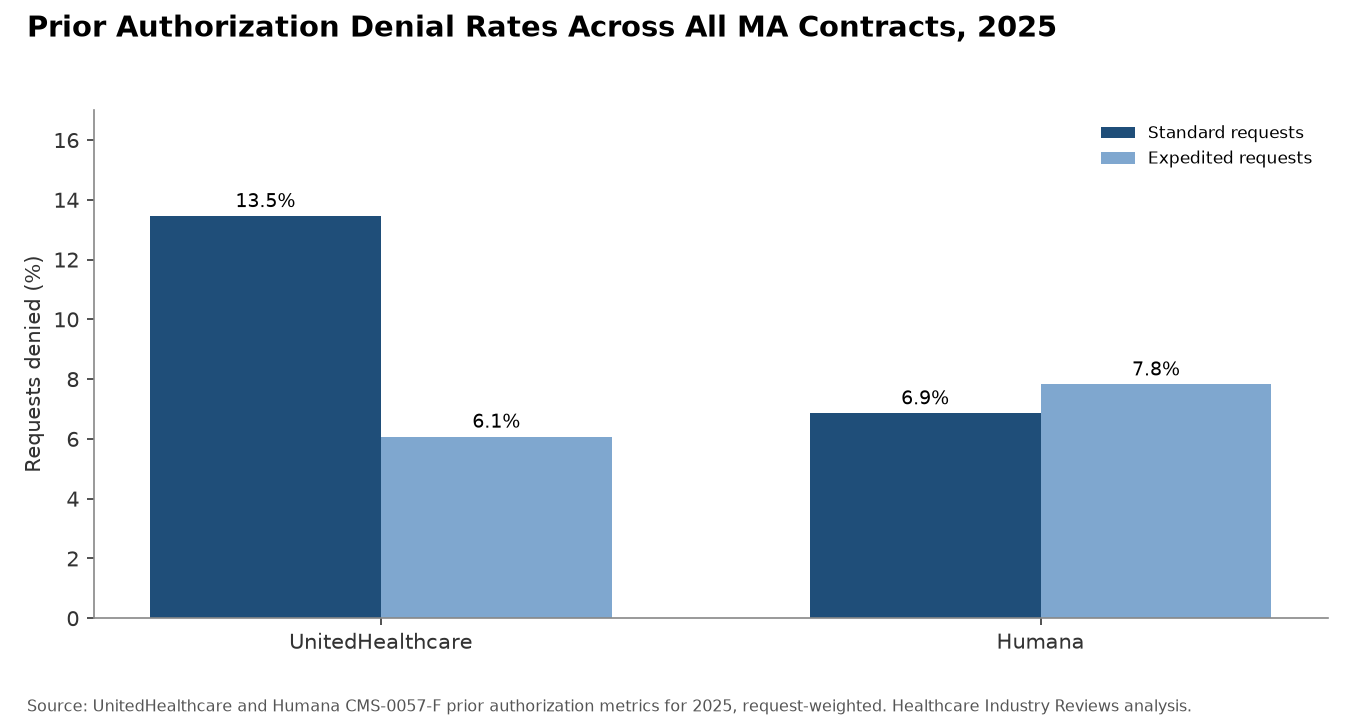
Our analysts studied those reports from UnitedHealthcare, Humana and Aetna. We measured denial rates by insurer and by contract, and how many denials were appealed and overturned. UnitedHealthcare denied 13.5% of standard prior authorization requests across its Medicare Advantage contracts in 2025, nearly twice Humana's rate of 6.9%.
In the following sections, we compare denial rates by insurer and by contract, then look at appeals and how often denials were overturned.
Prior Authorization Denial Rates by Insurer
UnitedHealthcare, Humana and Aetna are the three largest Medicare Advantage insurers. In March 2026, their parent companies, UnitedHealth Group, Humana and CVS Health, had 26%, 20% and 12% of all Medicare Advantage enrollees, according to KFF. UnitedHealthcare and Humana publish request counts, so their rates below are weighted by volume. Aetna publishes percentages only, so its figures are medians across contracts.
| Insurer | Contracts Reported | Standard Requests | Standard Requests Denied | Standard Denial Rate | Expedited Denial Rate | Median Contract Standard Denial Rate |
|---|---|---|---|---|---|---|
| UnitedHealthcare | 62 | 7,942,392 | 1,068,811 | 13.5% | 6.1% | 13.5% |
| Humana | 32 | 9,530,027 | 653,593 | 6.9% | 7.8% | 7.3% |
| Aetna | 42 | Not published | Not published | Not published | 13.2% (median) | 7.7% |
- Across 17.5 million standard requests at UnitedHealthcare and Humana, 1.7 million, or 9.9%, were denied.
- Humana handled 1.6 million more standard requests than UnitedHealthcare but denied 415,218 fewer.
- UnitedHealthcare denied fewer expedited requests than standard ones, 6.1% against 13.5%. Humana denied more, 7.8% against 6.9%.
- For Medicare Advantage members, the insurer affects how often prior authorization requests are denied. Each insurer now posts these rates for every contract on its own website, so members comparing plans can look them up and weigh them with premiums and other costs.
Denial Rates by Medicare Advantage Contract
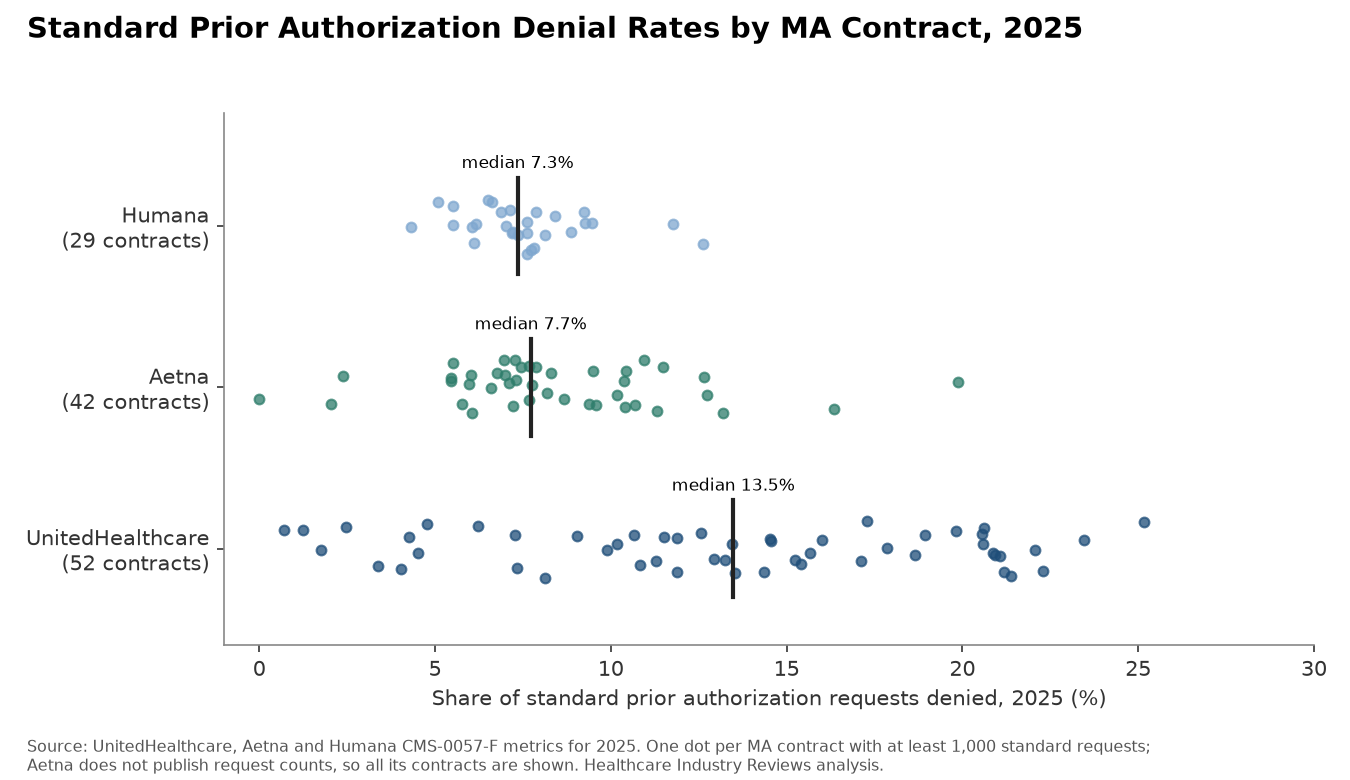
Each insurer runs dozens of contracts, which differ by region, plan type and network. Denial rates vary far more across UnitedHealthcare's contracts than across Humana's or Aetna's.
| Insurer | Lowest Contract | 10th Percentile | Median | 90th Percentile | Highest Contract | Contracts Above 15% |
|---|---|---|---|---|---|---|
| UnitedHealthcare | 0.7% | 4.0% | 13.5% | 21.2% | 25.2% | 22 of 52 |
| Humana | 4.3% | 5.5% | 7.3% | 9.3% | 12.6% | 0 of 29 |
| Aetna | 0.0% | 5.5% | 7.7% | 12.5% | 19.9% | 2 of 42 |
- 22 of UnitedHealthcare's 52 contracts with at least 1,000 standard requests denied more than 15% of those requests. None of Humana's did.
- UnitedHealthcare's largest contract by volume, H2001, denied 23.4% of its 1,854,050 standard requests. Its second largest, H0543, denied 1.8% of 1,569,659.
- Humana's largest contract, H5216, denied 6.9% of 4,238,164 standard requests.
- At UnitedHealthcare, a member's contract can change the odds of a denial several times over, so the insurer's overall rate may not describe a member's own plan. Most contracts at Humana and Aetna fall in a narrower range.
Prior Authorization Appeals and Overturns
When a request is denied, the enrollee or provider can appeal. The reports show how often appeals end in approval, though few denials are appealed.
| Insurer | Appeals Decided | Approved After Appeal | Share of Appeals Approved | Appeals per 100 Denials |
|---|---|---|---|---|
| UnitedHealthcare | 93,096 | 53,934 | 57.9% | 8.7 |
| Humana | 17,690 | 11,449 | 64.7% | 2.7 |
| Aetna | Not published | Not published | 87.8% (median contract) | Not published |
- Humana approved 64.7% of the 17,690 standard-request appeals it decided, and UnitedHealthcare approved 57.9%.
- Only 2.7 Humana denials and 8.7 UnitedHealthcare denials were appealed for every 100 standard denials.
- Because so few denials are appealed, few end in approval: 5.0 of every 100 UnitedHealthcare denials and 1.8 of every 100 Humana denials were approved after appeal.
How the three insurers compare with industry-wide figures
Every Medicare Advantage insurer also reports its prior authorization requests, denials and appeals to CMS for each contract, and KFF publishes an annual analysis of that data, most recently for 2024. A second KFF analysis pooled the 2025 metrics that the six largest Medicare Advantage insurers posted under the new rule.
| Data set | Year | Insurers covered | Denial rate | Denials appealed | Appeals overturned |
|---|---|---|---|---|---|
| CMS Part C reporting data, compiled by KFF | 2024 | All Medicare Advantage insurers | 7.7% of 52.8 million requests | 11.5% | 80.7% |
| Posted 2025 metrics, compiled by KFF | 2025 | Six largest insurers, 25 million enrollees | 12% standard, 10% expedited | Not reported | 67% |
| This study, UnitedHealthcare and Humana | 2025 | Two insurers, 94 contracts | 9.9% of 17.5 million standard requests | 6.4% | 59.0% |
- Medicare Advantage insurers fully or partly denied 4.1 million of 52.8 million prior authorization requests in 2024, or 7.7%, up from 6.4% in 2023 and close to the 7.4% of 2022.
- Only 11.5% of those denials were appealed in 2024, but 80.7% of appeals overturned the denial in full or in part.
- In the 2025 posted metrics, standard denial rates at the six largest insurers ranged from 5% at Elevance to 17% at UnitedHealth Group, and 67% of appealed denials were overturned.
- CMS data for 2024 put UnitedHealth Group's denial rate at 12.8% and Humana's at 5.8%, close to the 13.5% and 6.9% standard rates in the two insurers' own 2025 reports.
The CMS data for 2024 show the same gap between UnitedHealth Group and Humana as the insurers' own 2025 reports, and UnitedHealth Group had the highest standard denial rate of the six largest insurers in the 2025 posted metrics. The rates are not directly comparable with this study's figures: the CMS data count full and partial denials of all requests, KFF's 2025 averages are weighted by enrollment, and this study divides denied standard requests by total standard requests.
What Medicare Advantage Prior Authorization Trends Mean for 2027 and Beyond
Prior authorization decisions affect when Medicare Advantage members get tests, procedures and other services, and a denial that is never appealed stands unless the provider submits a new request.
Insurers' prior authorization reports covering 2026, due by March 31, 2027, will show whether the gaps between insurers and between contracts narrow.
So if your Medicare Advantage plan denies a request, file an appeal, because most appeals at the three insurers studied ended in approval.
Data Collection and Methodology
We compiled the figures from the 2025 prior authorization reports each insurer posted under the CMS Interoperability and Prior Authorization final rule (CMS-0057-F). The rule was finalized in 2024. Starting in 2026, it requires every Medicare Advantage insurer to post on its website, by March 31 each year, the share of prior authorization requests it approved and denied in the previous year for each of its contracts.
We downloaded UnitedHealthcare's Medicare Advantage report covering 63 contracts, 62 of which are in the study, Humana's 32 per-contract Medicare Advantage reports and Aetna's report covering 42 Medicare Advantage contracts, all for calendar year 2025. For all three insurers, the study includes both local contracts, whose numbers begin with H, and regional PPO contracts, whose numbers begin with R: 6 of UnitedHealthcare's 62 contracts, 6 of Humana's 32 and 1 of Aetna's 42 are regional PPO contracts. Insurer-wide denial rates for UnitedHealthcare and Humana divide total denied requests by total requests across all contracts. Medians and percentiles treat each contract equally. Contract-level figures, such as medians, percentiles and the lowest and highest contracts, leave out contracts with fewer than 1,000 standard requests, which excludes 10 of UnitedHealthcare's 62 contracts, 3 of Humana's 32 and none of Aetna's 42, because Aetna does not publish request counts. UnitedHealthcare reports "Initial Not Approved" requests and Humana and Aetna report "Request denied"; both are shown here as denials. Appeal figures cover standard requests at all three insurers, the only appeals the rule requires insurers to report. UnitedHealthcare also reports expedited appeals, which are not included. UnitedHealthcare publishes approvals after appeal as a count and a percentage of total appeals, and its appeal totals were derived by dividing one by the other. Three UnitedHealthcare contracts are left out of those derived totals: H2582 and H6824 had no approvals after appeal, so their totals cannot be derived, and R7444 reported no appeal percentage. The 63rd contract in UnitedHealthcare's report, which had 8 requests and no denials, is excluded, as are Humana's state Medicaid reports.
Denials include requests turned down for administrative reasons such as missing documents, for coverage reasons and for clinical reasons, and insurers differ in how they count requests submitted through delegated providers. An approval after appeal can follow new information and does not show the first decision was wrong. CMS also collects contract-level organization determination data from every Medicare Advantage insurer under its Part C reporting requirements, but releases it only as a Limited Data Set for purchase, so we did not analyze it directly. The industry-wide figures for 2022 to 2024 are KFF's totals from that data set, which count full and partial denials of all prior authorization requests. The 2025 industry figures are KFF's enrollment-weighted averages of the metrics posted by the six largest Medicare Advantage insurers, which together cover 25 million enrollees.
Sources
- Healthcare Industry Reviews, Medicare Advantage Prior Authorization Study: analysis of 2025 prior authorization metrics for 136 Medicare Advantage contracts posted by UnitedHealthcare, Humana and Aetna, conducted October 2026.
- UnitedHealthcare, CMS Interoperability Prior Authorization Metrics, Medicare Advantage, Calendar Year 2025
- Humana, Prior Authorization Metrics
- Aetna, 2025 Prior Authorization Metrics Report, Medicare Advantage
- CMS, Interoperability and Prior Authorization Final Rule (CMS-0057-F)
- Federal Register, Advancing Interoperability and Improving Prior Authorization Processes, final rule, 89 FR 8758, February 8, 2024 (42 CFR 422.122(c), publicly reporting prior authorization metrics)
- KFF, Medicare Advantage in 2026: Enrollment Update and Key Trends
- CMS, Parts C and D Reporting Requirements Limited Data Set
- KFF, Medicare Advantage Insurers Made Nearly 53 Million Prior Authorization Determinations in 2024 (Jan. 28, 2026)
- KFF, Prior Authorization Metrics Provide New Insights into Insurer Practices, but Gaps Remain (Aug. 13, 2026)