Rural Hospital Closure Statistics: 2026 Report
Published
Our analysts counted all 197 rural hospital closures that the Cecil G. Sheps Center for Health Services Research at the University of North Carolina has recorded since January 2005, by year, state, Medicare payment type, bed count, and the services left behind, and matched them with the 61 rural hospitals that have converted to Rural Emergency Hospitals since 2023. With Chartis's 2026 study of 2,081 rural hospitals, these lists show how many rural communities have lost inpatient care as of Q4 2026 and how many more hospitals are under financial strain.
Key Findings
- 154 rural hospitals closed or stopped providing inpatient care from 2010 through October 2026, 86 of them completely and 68 as converted closures that kept some outpatient or emergency services.
- Another 56 rural hospitals were operating as Rural Emergency Hospitals in October 2026, with an emergency department and no inpatient beds. Counting them, 210 rural hospitals have given up inpatient care since 2010.
- Texas has lost the most rural hospitals since 2010, 22 closures plus 7 Rural Emergency Hospital conversions, followed by Tennessee with 16 and Oklahoma with 15.
- Closures peaked at 17 a year in 2015 and 2019 and have not passed 7 in any year since 2021, while 49 hospitals converted to Rural Emergency Hospitals from 2023 through 2025.
- 41.2% of rural hospitals ran an operating loss in Chartis's February 2026 analysis, 52.2% in the 10 states that have not expanded Medicaid, and 417 rural hospitals were rated vulnerable to closure.
In many small towns, the local hospital is the only place to get emergency care, stay overnight for treatment, or give birth, and a large share of these hospitals lose money on their operations. When one closes, patients have to travel to the next town for that care, and the jobs at the hospital go with it. Since 2005, close to 200 rural hospitals have closed or stopped admitting patients. In 2023, Medicare added a new kind of provider, the Rural Emergency Hospital, which lets a small rural hospital give up its inpatient beds and keep an emergency department open. Some trackers count that change as a closure and some do not, so the national totals in news coverage can differ by dozens of hospitals for the same years. We wanted a count that shows both.
Our analysts copied the Cecil G. Sheps Center for Health Services Research's hospital-level list of rural hospital closures, which runs from January 2005 to the present, and counted it by year, state, Medicare payment type, bed count, and the services still offered at each site. We matched it with the Sheps Center's list of the 61 hospitals that have converted to Rural Emergency Hospitals, 56 of which still operate that way. We then compared both counts with Chartis's 2026 Rural Health State of the State report, which measured operating margins, closure risk, and lost services across 2,081 rural hospitals.
In the following sections, we break down closures by year and by state, look at what stays open after a rural hospital closes, count the conversions to Rural Emergency Hospitals, explain why the two most cited closure totals differ, and compare the finances of rural hospitals that are still open.
How Many Rural Hospitals Have Closed Each Year Since 2005
A single running total hides when closures happened and how complete they were. The Sheps Center separates complete closures, where the site stops offering any health care, from converted closures, where the inpatient beds go but some services stay, so we counted both for every year on its list.
| Year | Complete closures | Converted closures | Total |
|---|---|---|---|
| 2005 | 5 | 3 | 8 |
| 2006 | 4 | 5 | 9 |
| 2007 | 5 | 5 | 10 |
| 2008 | 6 | 0 | 6 |
| 2009 | 3 | 7 | 10 |
| 2010 | 2 | 1 | 3 |
| 2011 | 2 | 3 | 5 |
| 2012 | 4 | 5 | 9 |
| 2013 | 5 | 8 | 13 |
| 2014 | 8 | 6 | 14 |
| 2015 | 11 | 6 | 17 |
| 2016 | 5 | 5 | 10 |
| 2017 | 6 | 2 | 8 |
| 2018 | 9 | 4 | 13 |
| 2019 | 10 | 7 | 17 |
| 2020 | 8 | 8 | 16 |
| 2021 | 0 | 2 | 2 |
| 2022 | 3 | 4 | 7 |
| 2023 | 5 | 2 | 7 |
| 2024 | 4 | 1 | 5 |
| 2025 | 3 | 3 | 6 |
| 2026 (through October 30) | 1 | 1 | 2 |
| 2010 to 2026 | 86 | 68 | 154 |
| 2005 to 2026 | 109 | 88 | 197 |
Source: Cecil G. Sheps Center for Health Services Research, University of North Carolina, Rural Hospital Closures, list accessed October 30, 2026. Counted by Healthcare Industry Reviews. Conversions to Rural Emergency Hospitals are not included.
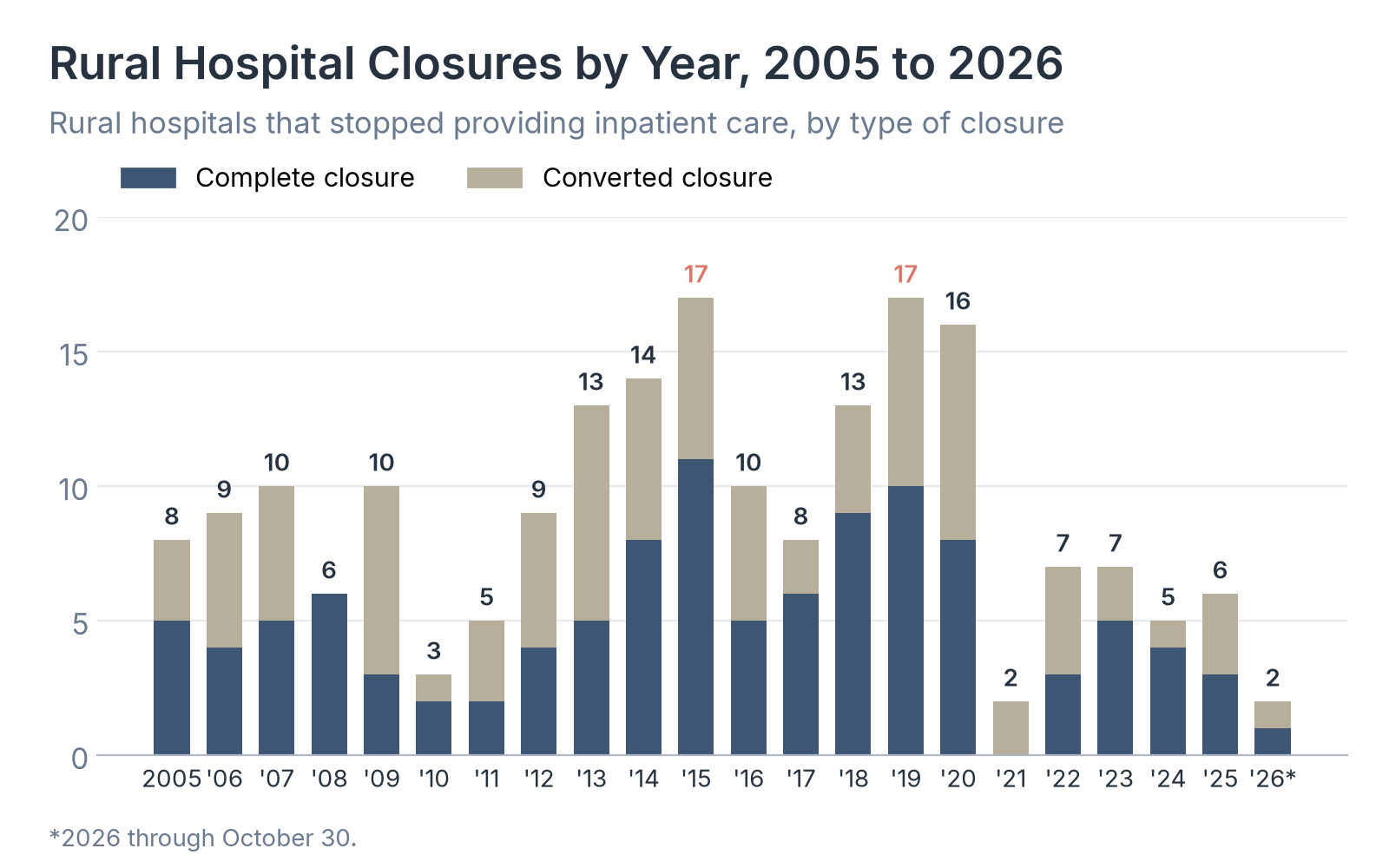
Source: Healthcare Industry Reviews analysis of the Sheps Center rural hospital closure list, October 30, 2026.
Key Findings
- The heaviest stretch ran from 2013 through 2020, when 108 rural hospitals closed or converted, an average of 13.5 a year. 2015 and 2019 had the most, 17 each.
- From 2021 through 2025 the list records 27 closures, fewer than the 33 in 2019 and 2020 alone, and 2021 had just 2. Two more hospitals closed in 2026: Bradford Regional Medical Center in Pennsylvania and Sturgis Hospital in Michigan, which had operated as a Rural Emergency Hospital.
- Complete closures outnumbered converted closures in 10 of the 22 years on the list, and converted closures were more common in 7. The slower pace since 2021 overlaps with the first years of the Rural Emergency Hospital option, which the following sections count separately.
Which States Have Lost the Most Rural Hospitals
Closures are concentrated in a small group of states, most of them in the South and the Great Plains. We tallied the Sheps list by state, added each state's current Rural Emergency Hospitals, and placed those totals beside the number of rural hospitals Chartis counts in each state today, which gives a sense of scale.
| State | Closures since 2005 | Closures since 2010 | Current Rural Emergency Hospitals | Total since 2010, including Rural Emergency Hospitals | Rural hospitals in 2026 (Chartis) |
|---|---|---|---|---|---|
| Texas | 25 | 22 | 7 | 29 | 150 |
| Tennessee | 14 | 14 | 2 | 16 | 44 |
| Oklahoma | 10 | 8 | 7 | 15 | 66 |
| Alabama | 9 | 8 | 5 | 13 | 45 |
| Missouri | 10 | 10 | 2 | 12 | 56 |
| Kansas | 9 | 8 | 3 | 11 | 99 |
| Mississippi | 5 | 4 | 7 | 11 | 57 |
| Georgia | 9 | 8 | 1 | 9 | 67 |
| North Carolina | 12 | 8 | 0 | 8 | 47 |
| Arkansas | 2 | 0 | 6 | 6 | 42 |
| New York | 5 | 3 | 3 | 6 | 49 |
| Pennsylvania | 7 | 6 | 0 | 6 | 40 |
Source: Cecil G. Sheps Center for Health Services Research, University of North Carolina, Rural Hospital Closures, list accessed October 30, 2026. Cecil G. Sheps Center for Health Services Research, University of North Carolina, Rural Emergency Hospitals, list accessed October 30, 2026. Chartis, 2026 Rural Health State of the State, February 10, 2026. The 12 states with the largest totals since 2010, including Rural Emergency Hospitals.
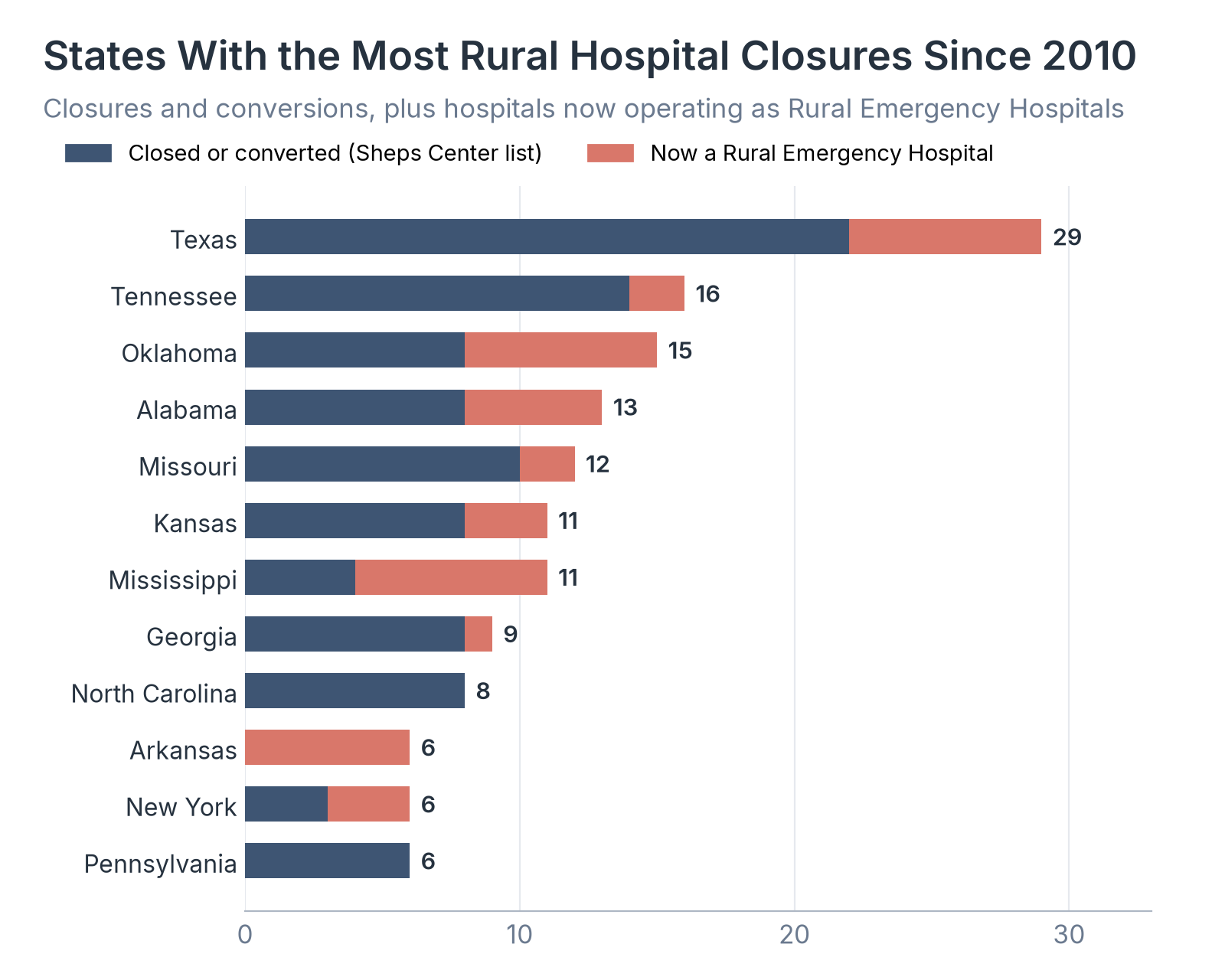
Source: Healthcare Industry Reviews analysis of the Sheps Center rural hospital closure and Rural Emergency Hospital lists, October 30, 2026.
Key Findings
- Texas has 25 closures on the Sheps list since 2005, more than any other state, and 7 Rural Emergency Hospitals. Tennessee's 14 closures since 2010 plus 2 conversions equal an estimated 27% of the rural hospitals the state had in 2010.
- Arkansas has no rural closure on the Sheps list since 2010 but 6 Rural Emergency Hospitals, and Mississippi has 4 closures and 7 conversions. In those states, hospitals have mostly converted to the new model in place of closing.
- 37 states have at least one rural closure on the Sheps list since 2005. Several of the leading states also have the most rural hospitals still open, Texas with 150 and Kansas with 99, so their totals reflect the size of their rural hospital networks as well as the strain on them.
What Remains After a Rural Hospital Closes
For people living nearby, the main question after a closure is whether anything stays open at the old hospital, such as an emergency room, a clinic, or a nursing home. The Sheps list records those remaining services for each site, along with the hospital's bed count and how Medicare paid it, so it also shows what kind of hospital tends to close.
| Services remaining | Closures since 2010 | Share since 2010 | Closures since 2005 | Share since 2005 |
|---|---|---|---|---|
| No health services | 86 | 55.8% | 109 | 55.3% |
| Emergency or urgent care | 29 | 18.8% | 32 | 16.2% |
| Outpatient, primary care, or clinic | 29 | 18.8% | 36 | 18.3% |
| Nursing, rehabilitation, or long-term care | 9 | 5.8% | 19 | 9.6% |
| Behavioral health | 1 | 0.6% | 1 | 0.5% |
Source: Cecil G. Sheps Center for Health Services Research, University of North Carolina, Rural Hospital Closures, list accessed October 30, 2026. Services as listed by the Sheps Center, grouped by Healthcare Industry Reviews.
| Medicare payment type before closure | Complete closures | Converted closures | Total | Share of closures |
|---|---|---|---|---|
| Prospective payment system hospital (PPS) | 42 | 35 | 77 | 39.1% |
| Critical Access Hospital (CAH) | 39 | 32 | 71 | 36.0% |
| Medicare-dependent hospital (MDH) | 18 | 13 | 31 | 15.7% |
| Sole community hospital (SCH) | 7 | 2 | 9 | 4.6% |
| Indian Health Service hospital (IHS) | 0 | 4 | 4 | 2.0% |
| Re-based sole community hospital | 0 | 2 | 2 | 1.0% |
| Rural Emergency Hospital (REH) | 2 | 0 | 2 | 1.0% |
| Rural referral center (RRC) | 1 | 0 | 1 | 0.5% |
Source: Cecil G. Sheps Center for Health Services Research, University of North Carolina, Rural Hospital Closures, list accessed October 30, 2026.
| Beds at closure | Hospitals | Share of closures |
|---|---|---|
| 25 or fewer | 115 | 58.4% |
| 26 to 50 | 47 | 23.9% |
| 51 to 100 | 31 | 15.7% |
| More than 100 | 4 | 2.0% |
Source: Cecil G. Sheps Center for Health Services Research, University of North Carolina, Rural Hospital Closures, list accessed October 30, 2026. Median bed count: 25.
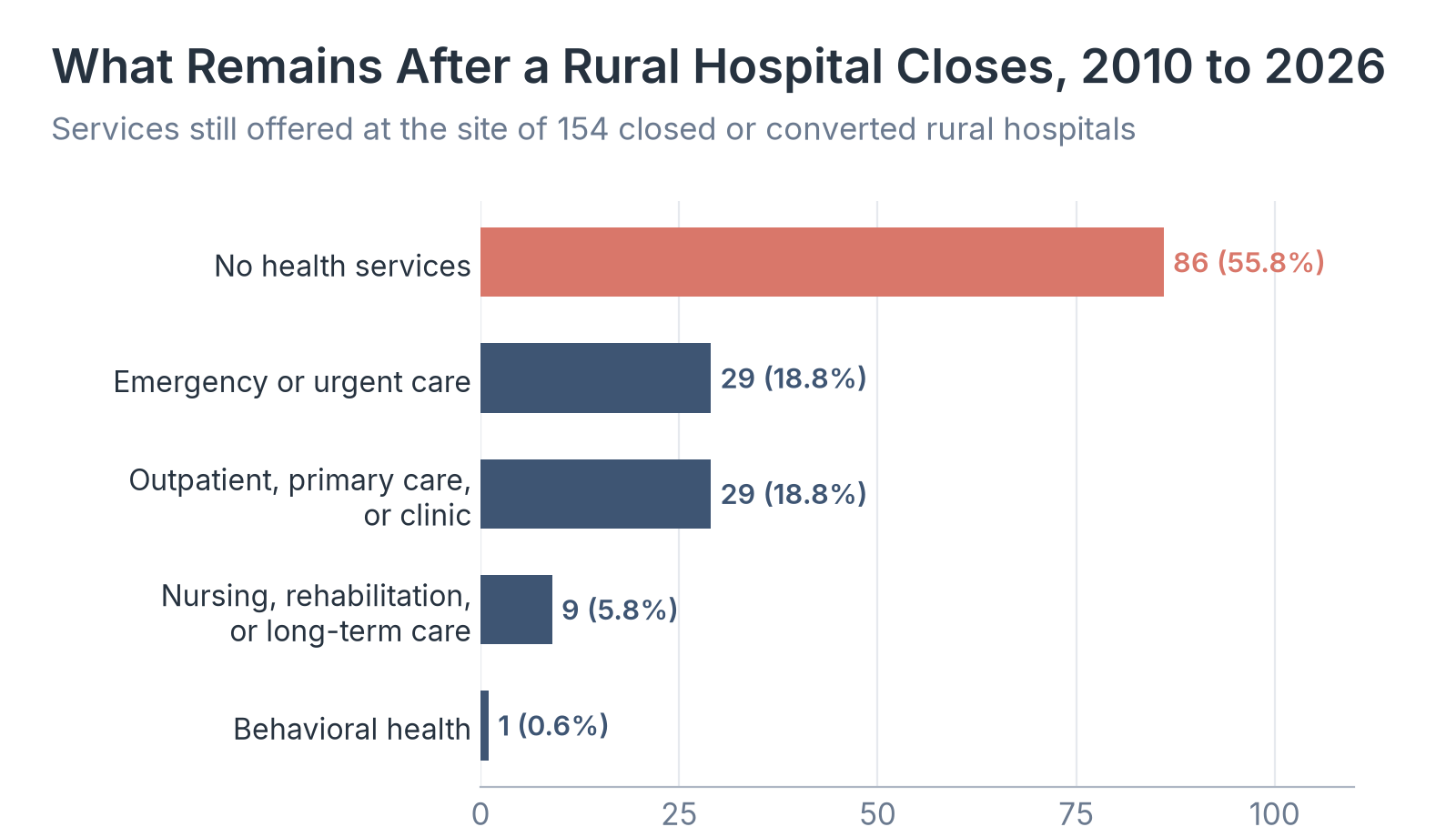
Source: Healthcare Industry Reviews analysis of the Sheps Center rural hospital closure list, October 30, 2026.
Key Findings
- Since 2010, 86 of 154 closed hospitals (55.8%) left no health services at the site. Another 29 (18.8%) kept emergency or urgent care, and 29 kept outpatient, primary care, or clinic services.
- Most closed hospitals were small: 115 of the 197 on the list since 2005 (58.4%) had 25 or fewer beds, and only 4 had more than 100. Critical Access Hospitals made up 71 of the closures and standard prospective payment system hospitals 77.
- Because closed rural hospitals are usually small, each one removes few beds from the national supply. For the town, though, the loss of those beds means an overnight hospital stay now requires a trip elsewhere.
How Many Rural Hospitals Have Become Rural Emergency Hospitals
The Rural Emergency Hospital is the newest option for a struggling rural hospital. Since 2023, Critical Access Hospitals and rural hospitals with 50 or fewer beds that were in Medicare as of December 27, 2020, can convert to Rural Emergency Hospitals, which keep emergency and outpatient care and stop admitting inpatients. The Sheps Center tracks every conversion on a separate list, and we counted it by year, state, and the hospital's Medicare payment type before it converted.
| Year of conversion | Hospitals converted | Still operating as a Rural Emergency Hospital |
|---|---|---|
| 2023 | 21 | 17 |
| 2024 | 18 | 17 |
| 2025 | 10 | 10 |
| 2026 (through August 12) | 12 | 12 |
| Total | 61 | 56 |
Source: Cecil G. Sheps Center for Health Services Research, University of North Carolina, Rural Emergency Hospitals, list accessed October 30, 2026. Counted by Healthcare Industry Reviews by Medicare participation date.
| State | Hospitals converted | Still operating as a Rural Emergency Hospital |
|---|---|---|
| Mississippi | 8 | 7 |
| Texas | 8 | 7 |
| Oklahoma | 7 | 7 |
| Arkansas | 6 | 6 |
| Alabama | 5 | 5 |
| Kansas | 3 | 3 |
| New York | 3 | 3 |
| Georgia | 3 | 1 |
Source: Cecil G. Sheps Center for Health Services Research, University of North Carolina, Rural Emergency Hospitals, list accessed October 30, 2026.
| Payment type before conversion | Hospitals converted | Share |
|---|---|---|
| Critical Access Hospital | 26 | 42.6% |
| Sole community hospital | 15 | 24.6% |
| Prospective payment system hospital | 13 | 21.3% |
| Medicare-dependent hospital | 7 | 11.5% |
Source: Cecil G. Sheps Center for Health Services Research, University of North Carolina, Rural Emergency Hospitals, list accessed October 30, 2026.
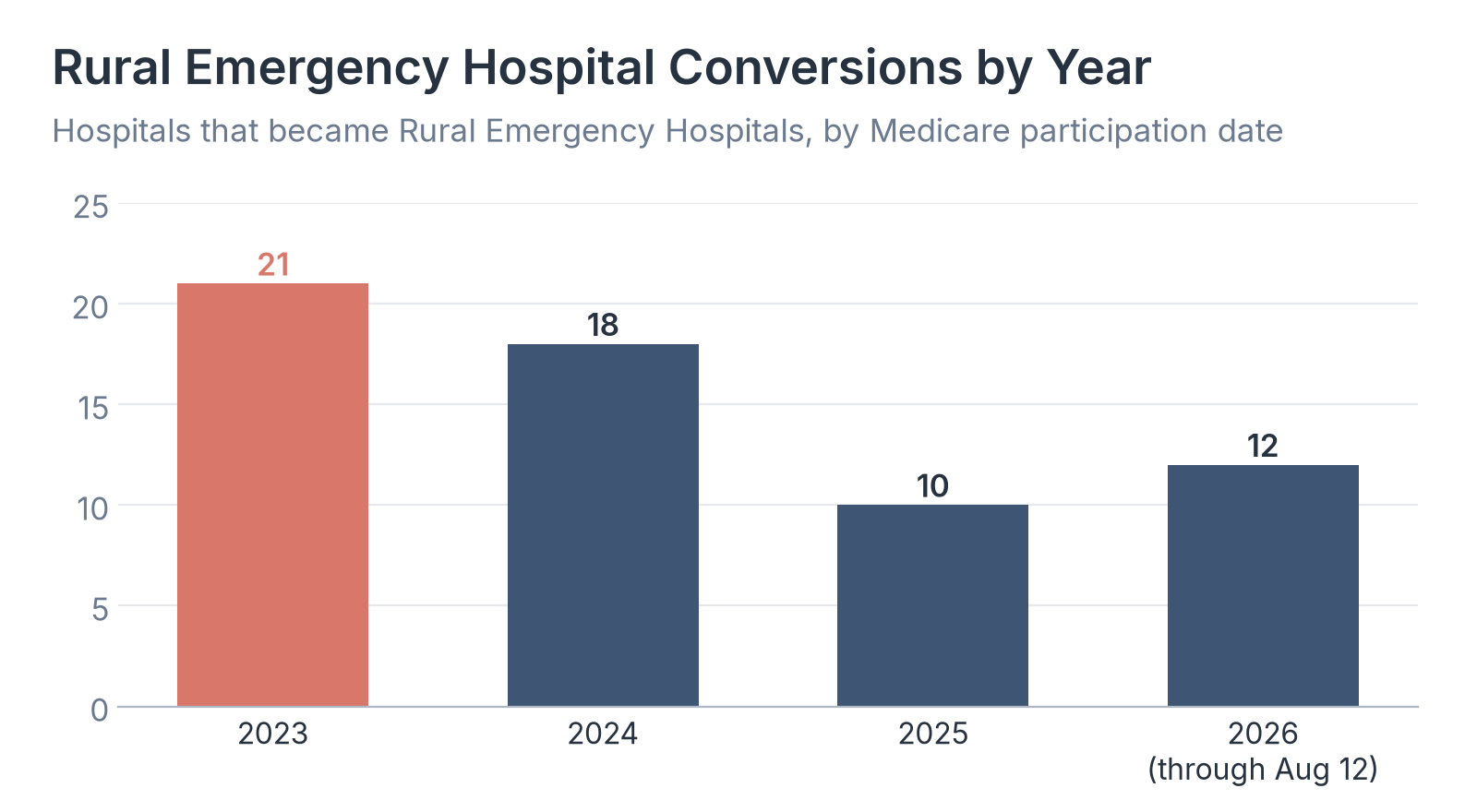
Source: Healthcare Industry Reviews analysis of the Sheps Center Rural Emergency Hospital list, October 30, 2026.
Key Findings
- 61 hospitals in 22 states have converted to Rural Emergency Hospitals since 2023. The first year brought the most conversions, 21, followed by 18 in 2024, 10 in 2025, and 12 in 2026 through August 12.
- Five conversions have ended: Sturgis Hospital in Michigan and St. Mark's Medical Center in Texas later closed, Blue Ridge Medical Center in Georgia converted back to a Critical Access Hospital, and two other hospitals changed to another hospital type.
- Mississippi and Texas have the most conversions, 8 each, followed by Oklahoma with 7 and Arkansas with 6. Since 2023, conversions have outnumbered closures on the Sheps list by 61 to 20, so the Rural Emergency Hospital is now the most common way a rural hospital stops inpatient care.
Why Rural Hospital Closure Counts Differ
Reporters often cite two national totals that seem to disagree. The difference comes from one rule: the Sheps Center does not count a conversion to a Rural Emergency Hospital as a closure, while Chartis counts every hospital that stopped inpatient care. We rebuilt both totals from the Sheps lists to show how they fit together.
| Count | Hospitals | What it includes |
|---|---|---|
| Sheps Center closures and conversions, 2010 to October 2026 | 154 | Complete and converted closures, excluding Rural Emergency Hospitals |
| Hospitals operating as Rural Emergency Hospitals, October 2026 | 56 | Current Rural Emergency Hospitals that are not on the closure list |
| Combined count, October 2026 | 210 | Both of the above |
| Chartis count, February 2026 | 206 | Closures and conversions to models without inpatient care, including Rural Emergency Hospitals, from Sheps Center and Definitive Healthcare data |
Source: Cecil G. Sheps Center for Health Services Research, University of North Carolina, Rural Hospital Closures, list accessed October 30, 2026. Cecil G. Sheps Center for Health Services Research, University of North Carolina, Rural Emergency Hospitals, list accessed October 30, 2026. Chartis, 2026 Rural Health State of the State, February 10, 2026. The combined count is a Healthcare Industry Reviews calculation.
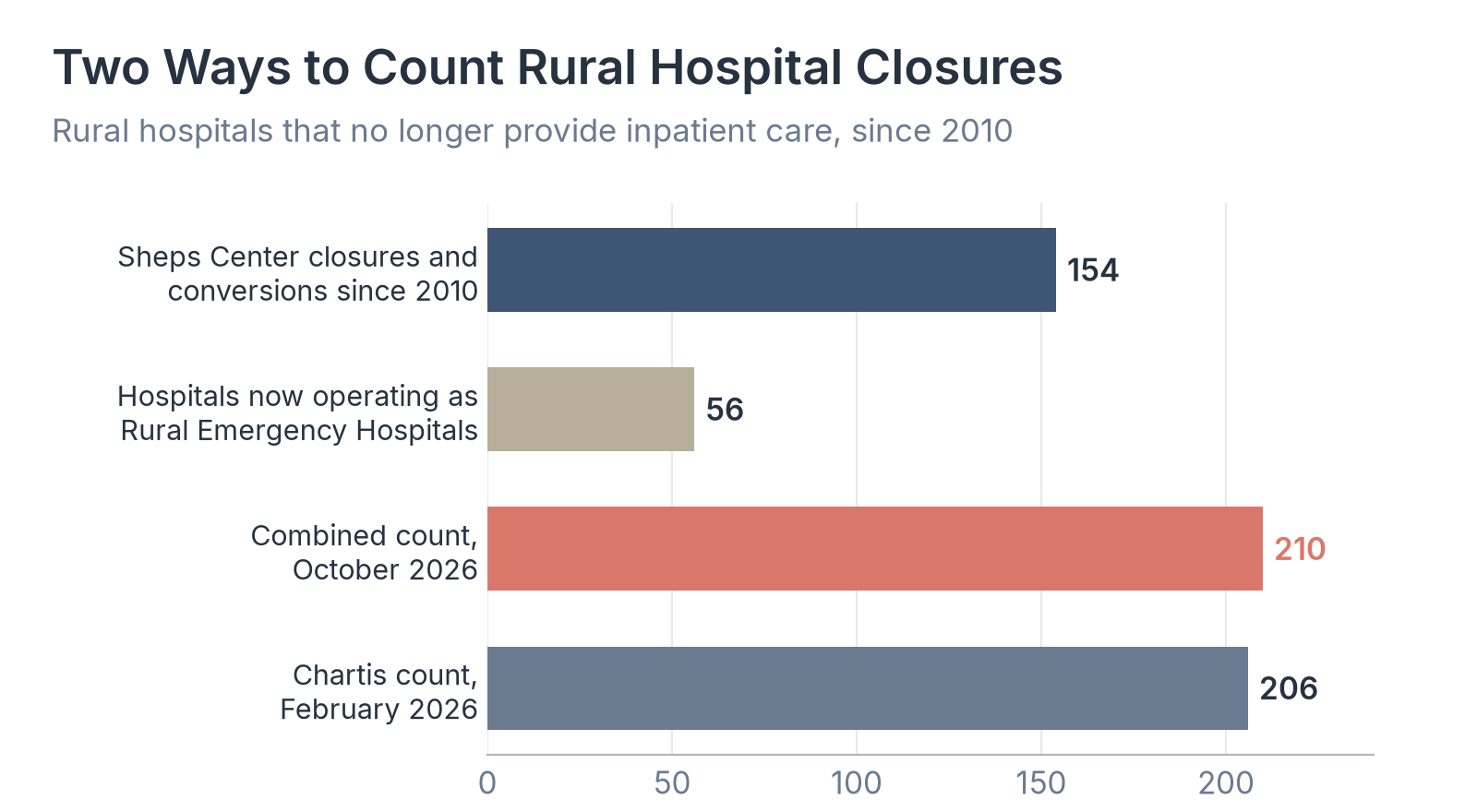
Source: Healthcare Industry Reviews analysis of the Sheps Center lists, October 30, 2026, and Chartis, February 10, 2026.
Key Findings
- Our combined count is 4 higher than the total Chartis reported in February 2026, and 10 hospitals converted to Rural Emergency Hospitals after that report was published. Chartis also draws on Definitive Healthcare data, so the two totals are not built from identical hospital lists.
- State totals differ for the same reason. Chartis lists Texas with 27 losses, Tennessee with 18, Oklahoma with 13, Kansas with 12, and Mississippi with 12 since 2010, while our combined count from the Sheps lists gives 29, 16, 15, 11, and 11.
- Either total can be accurate for its own question. The Sheps count fits a story about hospitals that shut their doors, while the Chartis-style count fits a story about rural communities that lost inpatient beds.
How Many Open Rural Hospitals Are Losing Money or at Risk of Closing
Closures usually follow years of losses, so the finances of rural hospitals that are still open show where pressure is building. Chartis measures each year how many rural hospitals lose money on operations, uses a statistical model to rate which ones are vulnerable to closure, and tracks the services rural hospitals have dropped.
| Group | Share in the red, 2025 | Share in the red, 2026 | Median operating margin, 2025 | Median operating margin, 2026 |
|---|---|---|---|---|
| All rural hospitals | 46% | 41.2% | Not reported | 2.0% |
| Medicaid expansion states | 43% | 34.9% | 1.5% | 2.9% |
| 10 non-expansion states | 53% | 52.2% | -1.1% | -0.7% |
Source: Chartis, 2026 Rural Health State of the State, February 10, 2026. Operating margins from CMS cost reports (HCRIS), third quarter of 2025.
| State | Vulnerable rural hospitals |
|---|---|
| Texas | 50 |
| Kansas | 44 |
| Tennessee | 27 |
| Georgia | 25 |
| Mississippi | 24 |
| All states | 417 |
Source: Chartis, 2026 Rural Health State of the State, February 10, 2026. Chartis also reports the highest shares of vulnerable hospitals in Tennessee (61%), Arkansas (55%), Florida (52%), Kansas (44%), South Dakota (42%), and Mississippi (42%).
| Service | Rural hospitals that stopped offering it | Period |
|---|---|---|
| Obstetrics | 331 | 2011 to 2024 |
| Chemotherapy | 448 | 2014 to 2024 |
| General surgery | More than 300 | Since 2014 |
Source: Chartis, 2026 Rural Health State of the State, February 10, 2026.
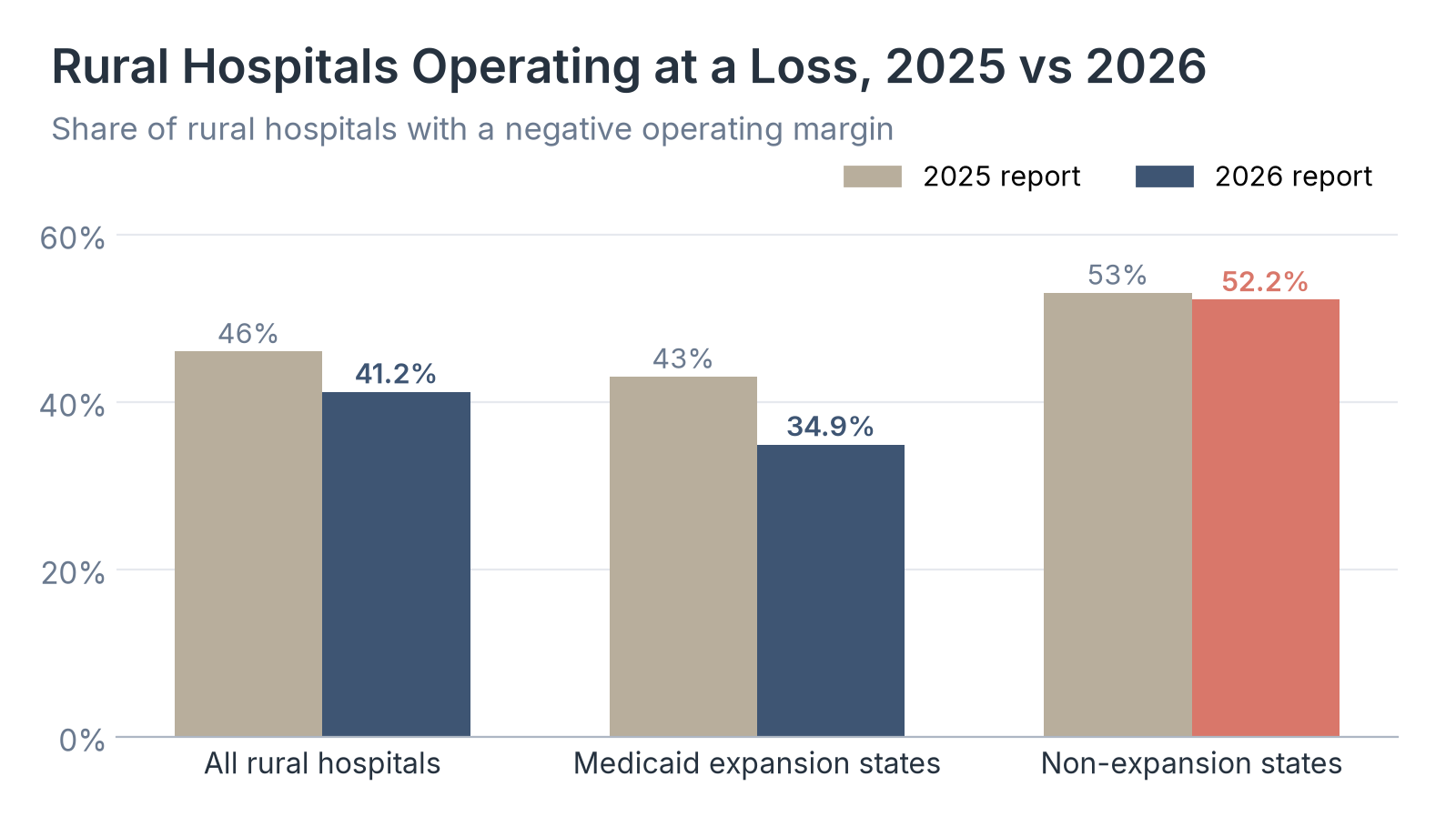
Source: Healthcare Industry Reviews analysis of Chartis, 2026 Rural Health State of the State, February 10, 2026.
Key Findings
- The share of rural hospitals in the red fell from 46% to 41.2% between Chartis's 2025 and 2026 reports, almost all of it in Medicaid expansion states, where the share fell from 43% to 34.9%. In the 10 non-expansion states it fell by less than one point.
- Kansas had the highest share of rural hospitals in the red, 86.2%, followed by Alabama at 67.6% and Arkansas at 59%. Texas had the most hospitals rated vulnerable to closure, 50, and Tennessee the highest share, 61%.
- The 331 rural hospitals that stopped delivering babies equal about 27% of the nation's rural obstetrics units, according to Chartis. Federal Medicaid cuts that start in 2027 are a further risk, since Medicaid makes up nearly 10% of net revenue at the typical rural hospital.
What Rural Hospital Closure Statistics Mean for Rural Communities in 2026
For people in rural towns, a closure most often means the building stops offering any care at all: more than half of the sites closed since 2010 left nothing behind. Since 2023, the Rural Emergency Hospital model has changed what a closure looks like in many places, and 56 towns that lost inpatient beds still have an emergency department.
Outright closures have slowed since 2020, but rural inpatient care keeps shrinking in quieter ways: through conversions, through hospitals that stop delivering babies or giving chemotherapy, and through the 417 hospitals Chartis rates as vulnerable. Counting closures and conversions together, an estimated 9% of the rural hospitals open in 2010 no longer admit patients. The $50 billion Rural Health Transformation program starts paying states in 2026, though Chartis expects states to spend only a small part of it on keeping rural hospitals stable.
So if you cite a rural hospital closure count, say whether it includes Rural Emergency Hospital conversions, because that one choice moves the national total since 2010 from 154 to 210.
Data Collection and Methodology
We opened the Sheps Center's Rural Hospital Closures page on October 30, 2026, and copied its sortable list of 197 closed rural hospitals, each with its state, rural-urban commuting area code, metropolitan or micropolitan area type, Medicare payment type, closure year, bed count, and remaining services. Our counts match the Sheps Center's published totals: 197 closures and conversions since January 2005 (109 complete and 88 converted) and 154 since 2010 (86 complete and 68 converted). The Sheps Center follows the HHS Office of Inspector General definition of a closed hospital, a facility that stopped providing general, short-term, acute inpatient care. It does not count mergers or sales where the building keeps inpatient care, conversions to Critical Access Hospitals or Rural Emergency Hospitals, or hospitals that closed and reopened in the same year at the same location. A complete closure provides no health services afterward; a converted closure keeps some services, such as primary care, emergency care, or skilled nursing. We grouped the remaining services listed for each converted closure into four categories.
We copied the Sheps Center's Rural Emergency Hospital list the same day: 61 hospitals with their state, prior Medicare payment type, participation date, and status. 56 operate as Rural Emergency Hospitals; five have ended that status. Two of those five, Sturgis Hospital and St. Mark's Medical Center, later closed and appear on the closure list, so our combined count adds only the 56 current Rural Emergency Hospitals to the 154 closures, which avoids counting any hospital twice.
Chartis figures come from its 2026 Rural Health State of the State, which defines rural hospitals as those in census tracts the Federal Office of Rural Health Policy designates as rural and excludes specialty hospitals, facilities on Native American territory, facilities that report under another hospital, and rural prospective payment system hospitals with more than 200 beds, for 2,081 hospitals in all. Its operating margins use CMS cost report data from the third quarter of 2025, its closure counts combine Sheps Center and Definitive Healthcare data, and its vulnerability index is a multilevel logistic regression model. Chartis reports its 2025 comparison figures as rounded percentages.
Two figures are estimates. Tennessee's losses since 2010 equal an estimated 27% of the rural hospitals it had in 2010: 16 losses divided by the 44 rural hospitals Chartis counts today plus those 16. Nationally, an estimated 9% of the rural hospitals open in 2010 no longer provide inpatient care: 210 divided by 2,081 plus 210. Both use Chartis's 2026 hospital counts, which use a different rural definition from the Sheps lists. All money figures are in US dollars, and no currency conversion was needed. We calculated products, differences, and ratios from the published values.
Sources
- Healthcare Industry Reviews, Rural Hospital Closure Study: analysis of the Sheps Center's hospital-level lists of 197 rural hospital closures since 2005 and 61 Rural Emergency Hospital conversions since 2023, by year, state, Medicare payment type, bed count, and remaining services, with published Chartis data on rural hospital finances, conducted October 2026.
- Cecil G. Sheps Center for Health Services Research, University of North Carolina at Chapel Hill. Rural Hospital Closures. Accessed October 30, 2026.
- Cecil G. Sheps Center for Health Services Research, University of North Carolina at Chapel Hill. Rural Emergency Hospitals. Accessed October 30, 2026.
- Chartis. 2026 Rural Health State of the State. February 10, 2026.