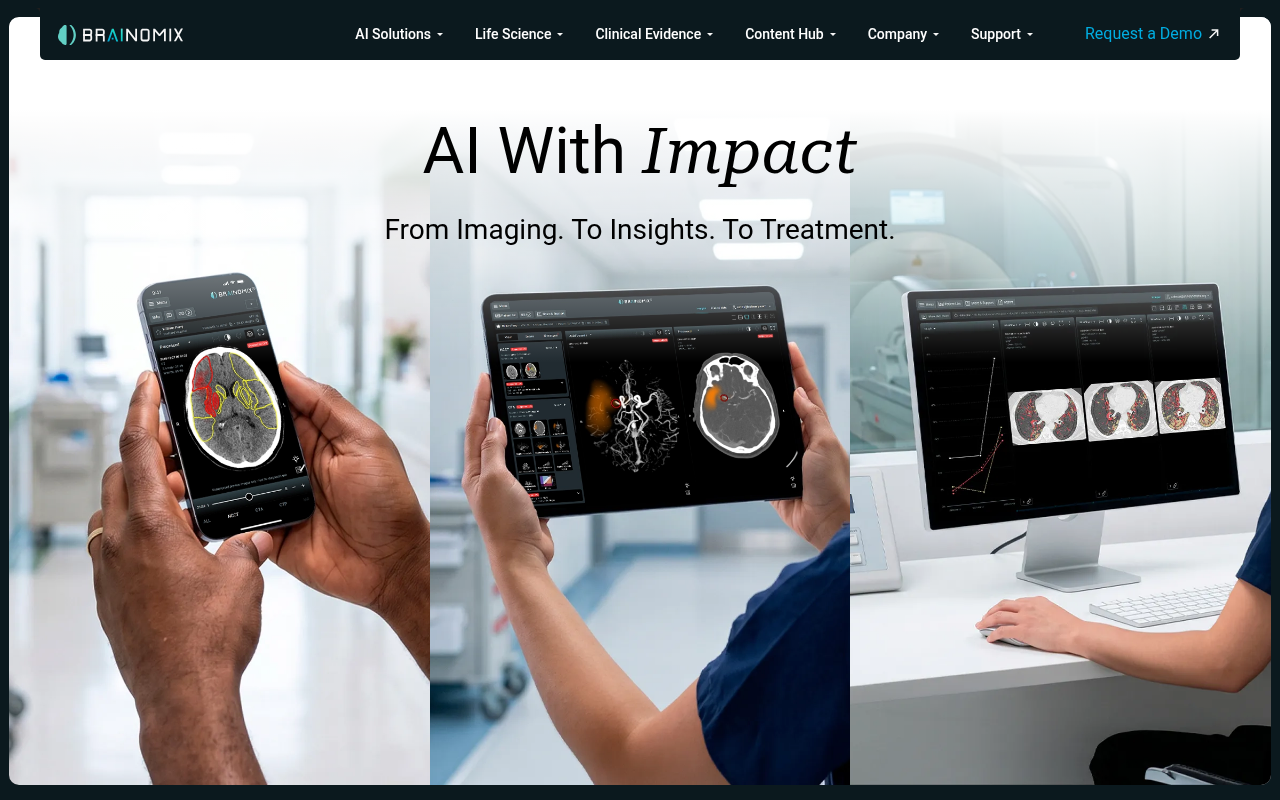
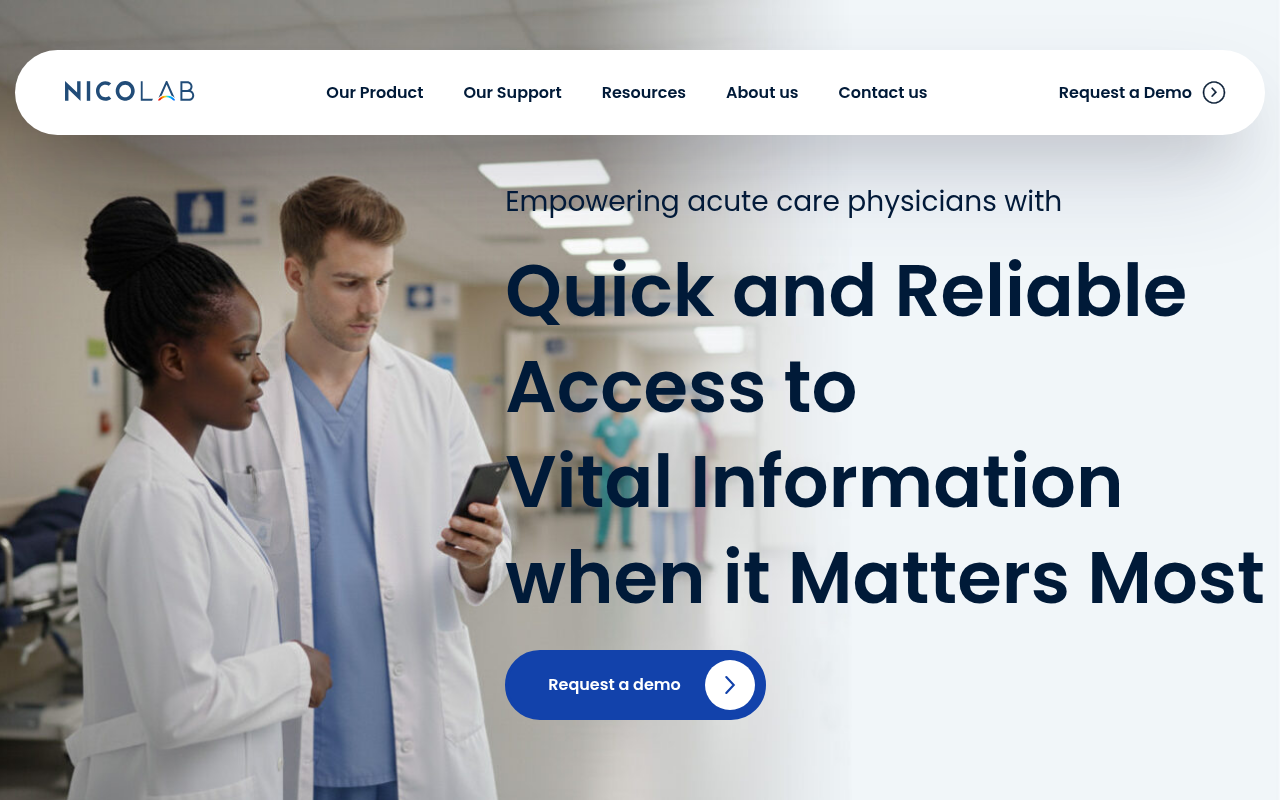
Regional and national stroke networks often compare Brainomix and Nicolab when they want AI to help smaller hospitals decide which stroke patients need clot removal or a transfer. Both spun out of university stroke research in Europe. Brainomix came from the University of Oxford, and Nicolab came from Amsterdam University Medical Center after the MR CLEAN trial, which proved the benefit of removing the clot through a catheter. Brainomix 360 Stroke reads CT and MRI stroke scans. Nicolab pairs its StrokeViewer scan analysis with Nicolab Assist, an app that lets doctors at different hospitals look at the same images and message each other.
Brainomix
7.8Overall
Recommend
Best for
Regional and national stroke networks that want proof from large real-world studies
Watch-out
Hospitals that want a single vendor for every imaging AI use
Nicolab
7.3Overall
Recommend
Best for
Regional stroke networks, including remote video stroke consult programs, that need images and messages shared between hospitals
Watch-out
Large U.S. comprehensive stroke centers that want the platform with the most U.S. studies
How they differ
Axis
Brainomix
Nicolab
Scan types it reads
✓Stronger
Non-contrast CT, CT angiography, CT perfusion, and MRI.
StrokeViewer flags blocked large arteries and analyzes CT perfusion scans.
Sharing a case between hospitals
Sells Vantage network analytics as an option, and its main product reads the scan.
✓Stronger
Nicolab Assist lets stroke teams at different hospitals see the same images and message each other from a phone or computer.
Real-world results
✓Stronger
A Lancet Digital Health study of more than 450,000 patients at 107 NHS England hospitals found clot-removal rates rose 100 percent at the 26 hospitals using it, compared with 63 percent at the others.
Hospitals in Australia and Europe using it performed 28 percent more clot removals in patients transferred in the early window.
Hospitals using it
✓Stronger
More than 300 hospitals in more than 20 countries, including national rollouts in Hungary and Wales in 2021.
More than 200 hospitals by 2023, including the U.S. Department of Veterans Affairs.
Uses beyond stroke
✓Stronger
Its e-Lung software measures lung fibrosis, which is scarring of the lungs, on CT and is cleared by the FDA.
Built for stroke only.
Getting hospitals live
✓Stronger
Scores 7.7, and it needs a network lead and baseline data to measure results against.
Scores 7.3, and every hospital in the network has to agree to share images.
Ways to buy
≈Similar
Subscription by hospital or network, with national and regional contracts in Europe.
≈Similar
Subscription by network, also sold through the Harrison.ai Open Platform, where hospitals pay Nicolab directly with no platform markup.
Knowing what you will pay
≈Similar
Priced by hospital, scan types, network analytics, and whether e-Lung is added, with no public price list.
≈Similar
Priced by hospital, StrokeViewer tools, and Nicolab Assist users, with no public price list.
Verdict
Brainomix is for a national or regional stroke program that wants the strongest real-world outcome data, needs several kinds of stroke scans read, and may also want AI for lung fibrosis. Nicolab is for a network where moving patients between hospitals is the hard part, so shared images and messaging matter as much as the scan reading, and for hospitals in Australia and Europe that want a vendor with local support.
Walk away from both if you want one vendor for every kind of imaging AI, since both focus on stroke. Walk away from Nicolab if you run a large U.S. comprehensive stroke center that wants the most U.S. studies. Walk away from Brainomix if no one will lead the network rollout and collect baseline data before it starts.