Physician Unionization Statistics: 2026 Report
Published
Our analysts reviewed 13,282 National Labor Relations Board union election tallies from January 2019 through November 6, 2026, and identified 105 elections in units that included physicians, residents, or fellows. We paired them with published physician union membership estimates and federal membership rates to show how many doctors are unionizing, where, and with which unions as of Q4 2026.
Key Findings
- The NLRB tallied 105 union elections in bargaining units that included physicians, residents, or fellows from January 2019 through November 6, 2026, and unions won 98 of them (93.3%).
- Physician union elections rose from 10 in 2022 to 27 in 2023, then held at 24 in 2024 and 22 in 2025. Unions won 71 of the 73 elections held from 2023 through 2025.
- Units that voted to unionize covered 23,846 eligible voters, and 17,973 of them (75.4%) were in resident and fellow units.
- An estimated 8% of US physicians belonged to a union in 2024, up from 5.7% in 2014, compared with 10.0% of all US wage and salary workers in 2025.
- Oregon had the most physician union elections (19), followed by California (16) and Washington (10).
In 1983, 75.8% of US physicians owned their primary practice. Today nearly 80% are employed by health systems or other corporations, and as employees they are eligible to unionize. Residents and fellows, doctors still in training, have always been employees, and hospital residents formed the first physicians' union in 1934, but those unions grew slowly for eight decades. Starting in 2023, union drives spread quickly through teaching hospitals and among employed attending physicians. Doctors who filed for union elections cited working conditions and a voice in how their workplaces are run far more often than pay. Reporters, health system executives, and physician groups want to know how many doctors have unionized, how fast, and where. Federal election records give the most complete count of new physician unions at private employers.
Our analysts reviewed all 13,282 union election tallies posted in the National Labor Relations Board's election results data with tally dates from January 1, 2019, through November 6, 2026. We kept the 105 elections whose bargaining units included physicians, residents, interns, or fellows, removed duplicate tallies of the same case, and sorted each unit by who it covered and which union ran the election. We then compared the results with published physician union membership estimates and with Bureau of Labor Statistics membership rates for other workers.
In the following sections, we compare physician union elections by year, unit type, union, and state, and then place them against the share of physicians and other workers who belong to unions.
How Many Physician Union Elections Are Held Each Year
When employees at a private employer petition to form a union, the NLRB usually holds a secret-ballot election, and the union wins if a majority of votes cast are in favor. We counted elections in units that include physicians by the year the votes were tallied.
| Tally year | Elections | Union won | Union lost | Win rate | Eligible voters in winning units | Share of votes for the union |
|---|---|---|---|---|---|---|
| 2019 | 3 | 3 | 0 | 100% | 160 | 66.9% |
| 2020 | 3 | 2 | 1 | 67% | 51 | 76.6% |
| 2021 | 4 | 4 | 0 | 100% | 234 | 85.0% |
| 2022 | 10 | 8 | 2 | 80% | 2,430 | 81.3% |
| 2023 | 27 | 27 | 0 | 100% | 8,699 | 78.8% |
| 2024 | 24 | 22 | 2 | 92% | 6,360 | 84.8% |
| 2025 | 22 | 22 | 0 | 100% | 4,999 | 87.3% |
| 2026 (through Nov. 6) | 12 | 10 | 2 | 83% | 913 | 69.5% |
| Total, 2019 to 2026 | 105 | 98 | 7 | 93% | 23,846 | 81.9% |
Source: Healthcare Industry Reviews analysis of National Labor Relations Board election results, conducted November 2026. Units include physicians, residents, or fellows; some also include other clinicians.
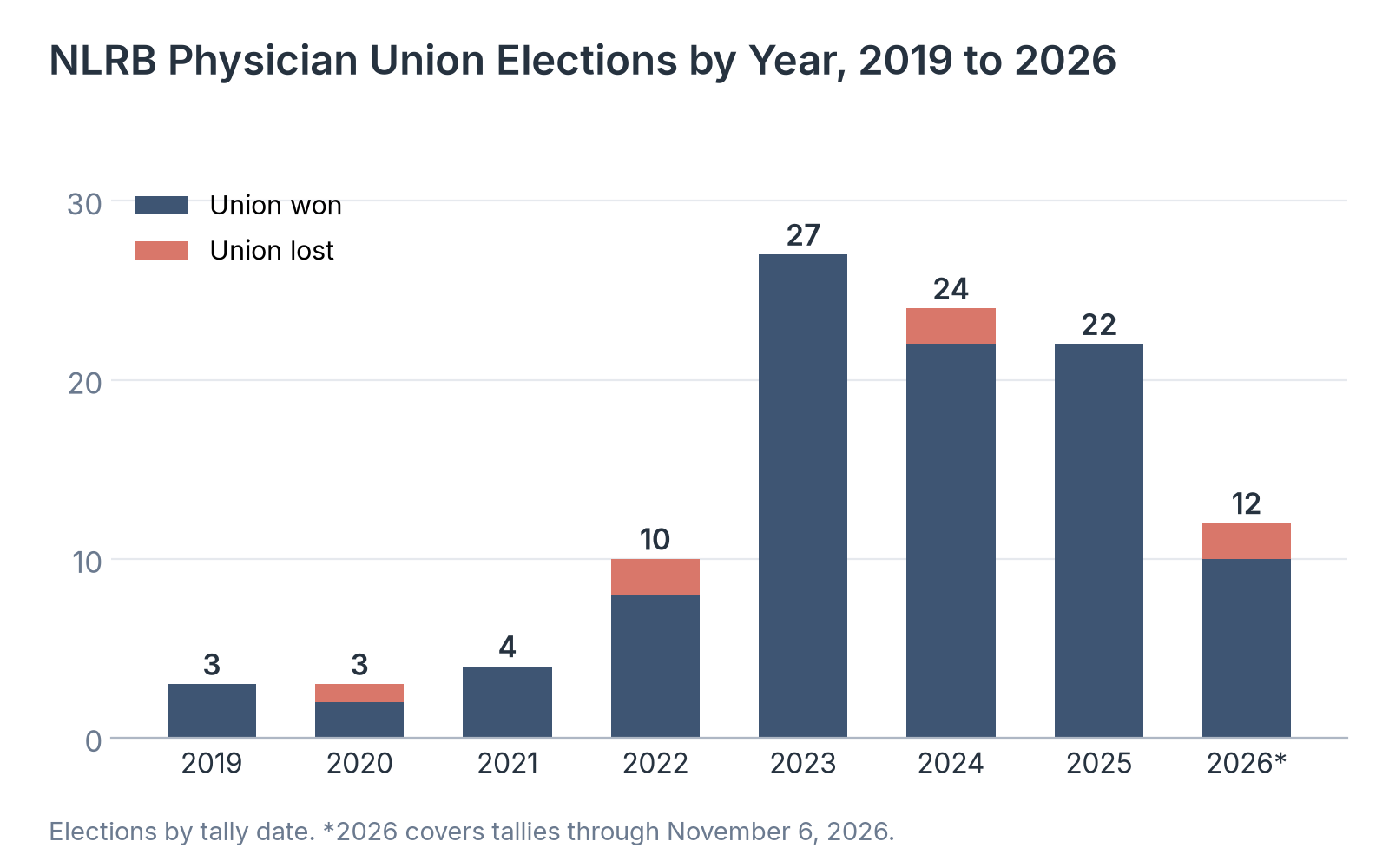
Source: Healthcare Industry Reviews analysis of National Labor Relations Board election results, conducted November 2026.
Key Findings
- From 2019 through 2022, the NLRB tallied 20 physician union elections. From 2023 through 2025, it tallied 73, and unions won 71 of them, covering 20,058 eligible voters.
- Unions won every physician election in 2023 (27) and 2025 (22). In 2025, 87.3% of the votes cast went to the union, the highest share of any year in the period.
- The 12 elections tallied in 2026 through November 6 are the fewest since 2022, and none involved a resident unit, after 12 resident elections in 2025. Every 2026 election so far has been among attending physicians, alone or with other clinicians, which shows organizing spreading from training programs to employed doctors. A JAMA study counted 33 union petitions with physician members filed in 2023 and 2024, compared with 44 from 2000 through 2022.
Which Kinds of Doctors Are Unionizing
Physician unions form in different kinds of bargaining units. Some cover only residents and fellows, some cover attending physicians alone, some add nurse practitioners and physician assistants, and some include a wider group of clinic staff. We sorted every election into one of those four groups.
| Unit type | Elections | Union won | Win rate | Eligible voters in winning units | Median eligible voters per unit |
|---|---|---|---|---|---|
| Residents and fellows | 32 | 31 | 97% | 17,973 | 477.5 |
| Physicians only | 24 | 22 | 92% | 2,007 | 59 |
| Physicians and advanced practice clinicians | 15 | 14 | 93% | 1,443 | 45 |
| Broader mixed units | 34 | 31 | 91% | 2,423 | 39 |
Source: Healthcare Industry Reviews analysis of National Labor Relations Board election results, conducted November 2026. Broader mixed units also include roles such as nurses, therapists, or social workers.
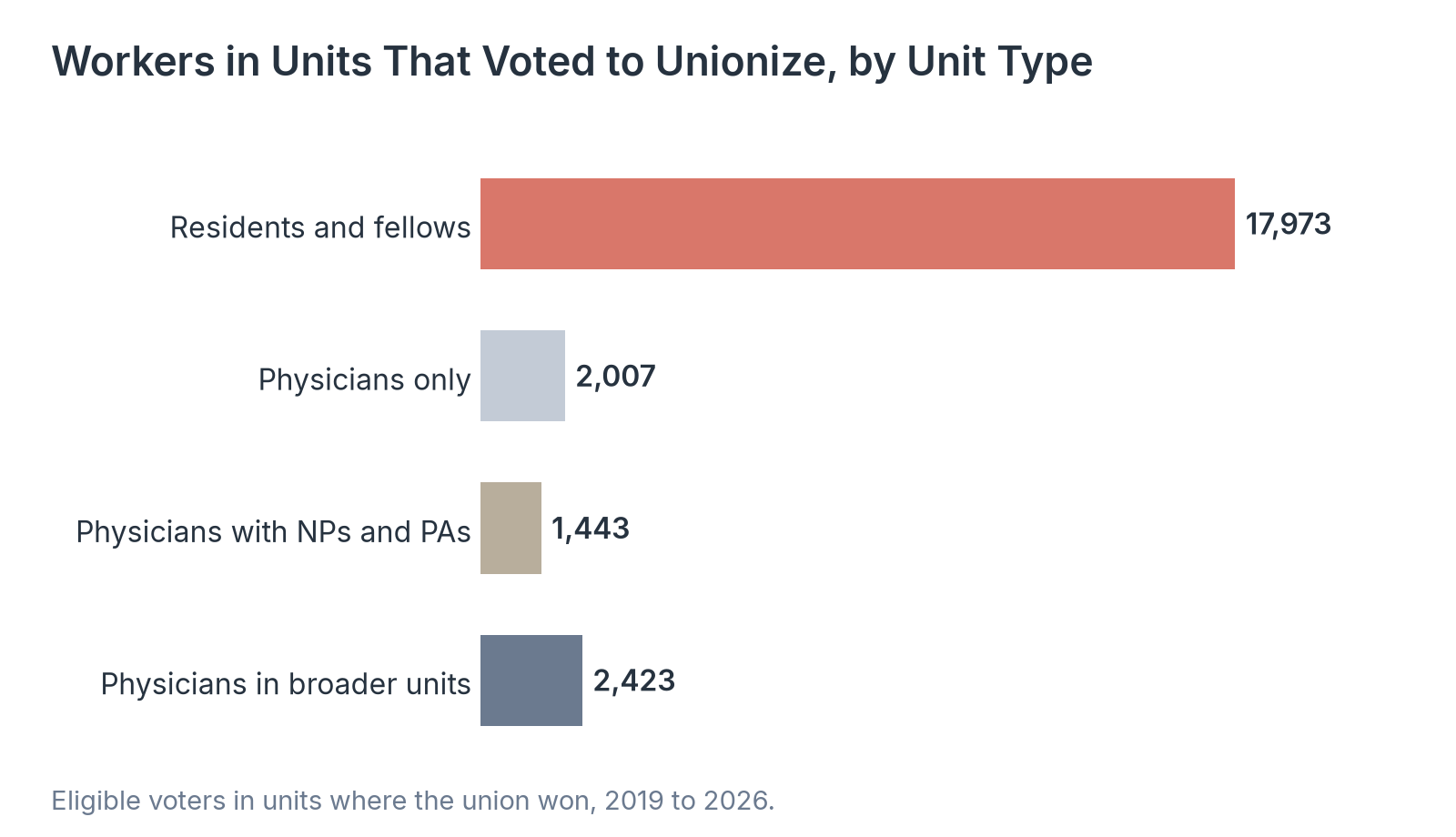
Source: Healthcare Industry Reviews analysis of National Labor Relations Board election results, conducted November 2026.
Key Findings
- Resident and fellow units accounted for 32 of the 105 elections but 17,973 of the 23,846 eligible voters in winning units. The median resident unit had 477.5 eligible voters, compared with 59 for attending physician units.
- The largest single unit was 2,304 residents and fellows at Mass General Brigham, who voted to unionize in June 2023. Stanford (1,450), Penn (1,394), and two Chicago programs (1,283 and 1,031) followed.
- Units of attending physicians alone, or with nurse practitioners and physician assistants, held 39 elections and won 36, but those wins covered 3,450 eligible voters. Attending physician organizing happens one small group at a time, so growth in attending union membership will build slowly even as elections keep coming.
Which Unions Represent Physicians
A handful of unions ran most physician elections, and each draws from a different group of doctors. We grouped elections by the union on the ballot.
| Union | Elections | Union won | Eligible voters in winning units | Wins in resident and fellow units |
|---|---|---|---|---|
| Committee of Interns and Residents (SEIU) | 27 | 26 | 14,439 | 26 |
| Union of American Physicians and Dentists (AFSCME) | 22 | 19 | 3,028 | 2 |
| Pacific Northwest Hospital Medicine Association and Northwest Medicine United (AFT) | 18 | 18 | 941 | 0 |
| Doctors Council (SEIU) | 4 | 4 | 1,450 | 0 |
| Other unions | 34 | 31 | 3,988 | 3 |
Source: Healthcare Industry Reviews analysis of National Labor Relations Board election results, conducted November 2026.
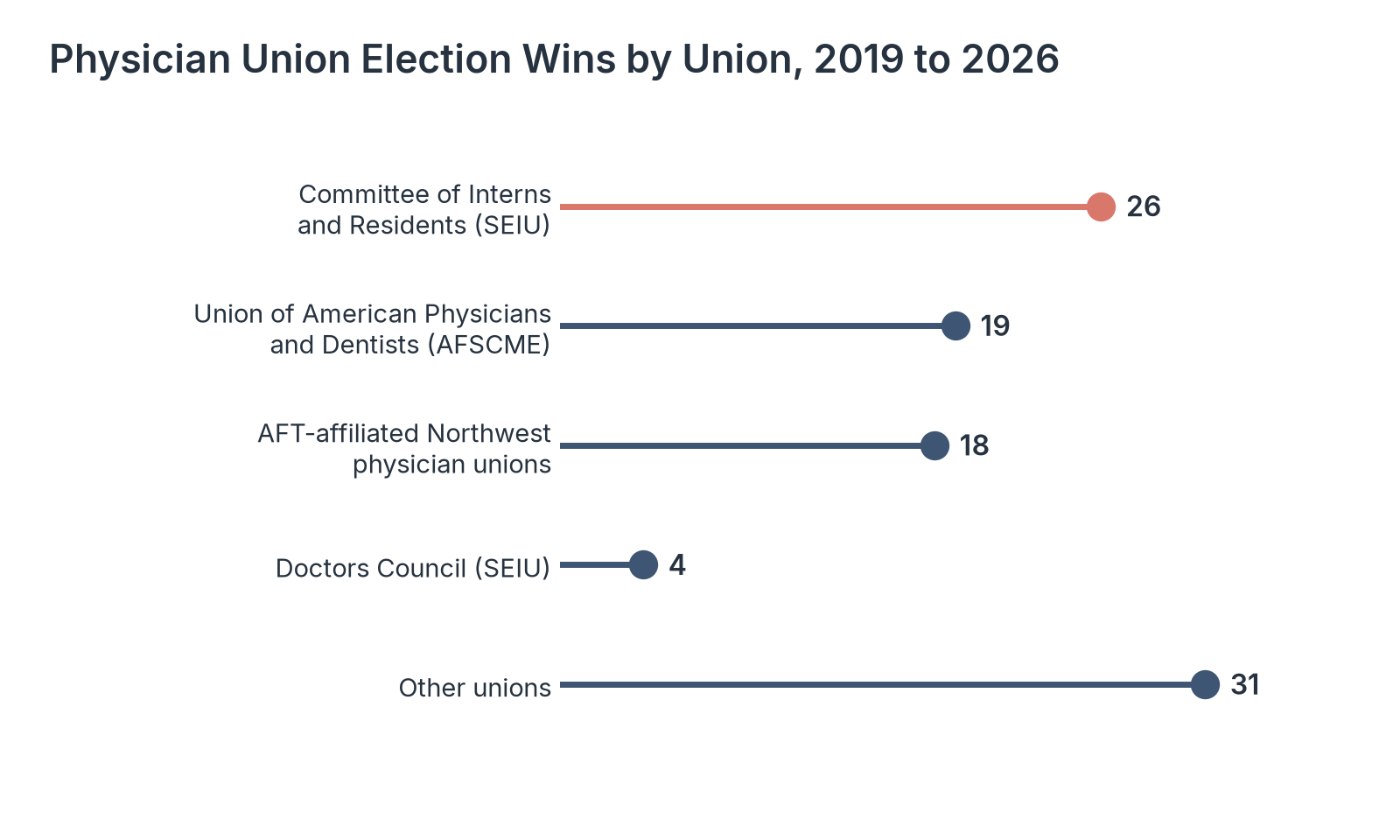
Source: Healthcare Industry Reviews analysis of National Labor Relations Board election results, conducted November 2026.
Key Findings
- The Committee of Interns and Residents, part of SEIU, won 26 of 27 elections, all in resident and fellow units, covering 14,439 eligible voters. Its membership grew from 17,000 in 2021 to more than 40,000 in 2025.
- The Union of American Physicians and Dentists, part of AFSCME, won 19 of 22 elections, mostly among attending physicians, and two AFT-affiliated hospitalist and physician unions in Oregon and Washington won all 18 of theirs.
- Thirty-four elections, nearly a third, went to other unions, including the National Union of Healthcare Workers, AFSCME and SEIU locals, and AFT resident groups in Michigan and Maryland. Physicians at a given employer can choose among several unions, and the field is widening: SEIU launched Doctors United, a national physicians' union, in May 2025.
Where Physicians Are Unionizing
Physician union elections cluster in a few states with large health systems, many employed doctors, and big teaching hospitals. We counted elections by the city and state of each bargaining unit.
| State | Elections | Union won | Eligible voters in winning units |
|---|---|---|---|
| Oregon | 19 | 18 | 1,155 |
| California | 16 | 14 | 3,517 |
| Washington | 10 | 9 | 502 |
| Massachusetts | 8 | 7 | 3,536 |
| New York | 8 | 8 | 2,089 |
| Pennsylvania | 7 | 6 | 3,563 |
| Rhode Island | 4 | 4 | 919 |
| New Mexico | 4 | 3 | 280 |
| Illinois | 3 | 3 | 2,341 |
| Minnesota | 3 | 3 | 1,150 |
| Maryland | 3 | 3 | 1,008 |
| Delaware | 3 | 3 | 870 |
| District of Columbia | 3 | 3 | 735 |
Source: Healthcare Industry Reviews analysis of National Labor Relations Board election results, conducted November 2026. States with at least three elections; 22 states and the District of Columbia had at least one.
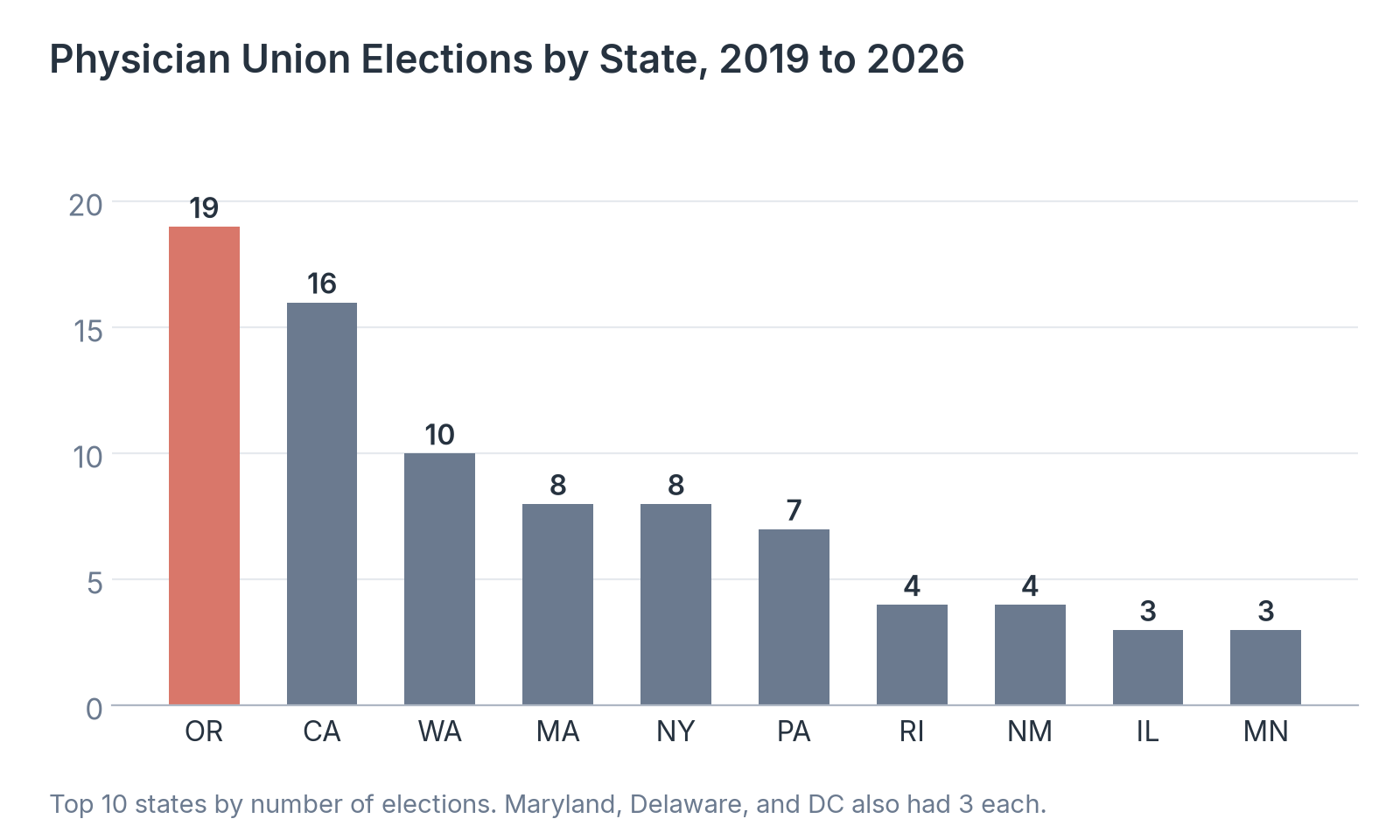
Source: Healthcare Industry Reviews analysis of National Labor Relations Board election results, conducted November 2026.
Key Findings
- Oregon had 19 physician union elections, more than any other state, and unions won 18. Most were small hospitalist and clinic units, so the wins covered 1,155 eligible voters.
- Pennsylvania (3,563), Massachusetts (3,536), and California (3,517) had the most eligible voters in winning units, driven by large resident units in Philadelphia, Boston, and Palo Alto.
- Oregon, California, and Washington together held 45 of the 105 elections. The JAMA study found the same concentration, with 43 of 77 physician union petitions filed in those three states, so West Coast health systems have the most direct experience bargaining with doctors.
How Many Physicians Belong to Unions
Election counts show new organizing, while membership rates show how much of the profession is already in a union. We gathered the most recent published estimates for physicians and compared them with federal rates for other US workers.
| Group | Year | Union membership rate |
|---|---|---|
| Physicians | 2014 | 5.7% |
| Physicians | 2019 | 7.2% |
| Physicians | 2024 | About 8% (estimate) |
| Healthcare practitioners and technical occupations | 2025 | 12.0% |
| Health care and social assistance industry | 2025 | 6.8% |
| All wage and salary workers | 2025 | 10.0% |
| Private-sector workers | 2025 | 5.9% |
Source: Physician rates from The Conversation, September 10, 2025, which describes the 2024 figure as an estimate. Other rates from U.S. Bureau of Labor Statistics, Union Members 2025 and Table 3, February 18, 2026.
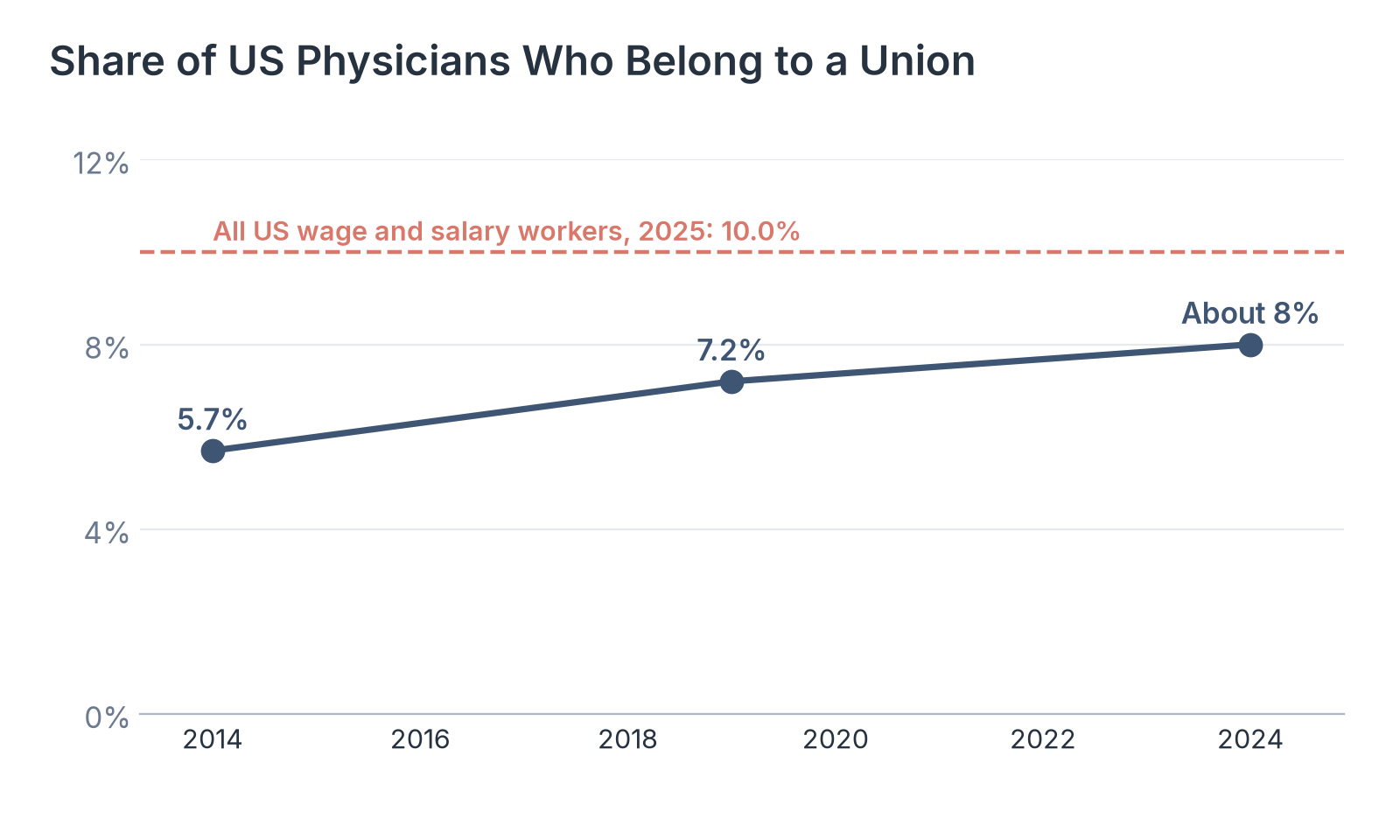
Source: The Conversation; U.S. Bureau of Labor Statistics, Union Members 2025.
Key Findings
- The share of physicians in a union rose from 5.7% in 2014 to an estimated 8% in 2024. Over a longer span, the rate for all US workers fell from 20.1% in 1983 to 9.9% in 2024.
- Physicians remain below the 12.0% rate for healthcare practitioners and technical occupations as a whole, a group that includes registered nurses, but above the 5.9% rate for private-sector workers.
- Across all healthcare employers, union elections fell to 280 in 2025 from 369 in 2024, while the union win rate rose to 89% from 77%. Physician elections followed the same pattern, dipping from 24 in 2024 to 22 in 2025 while unions won all 22, which points to steady gains in the physician membership rate.
What Physician Unionization Means for Health Systems
Physician unions are still a small part of the profession, but they have grown faster since 2023 than at any point in the NLRB records we reviewed. Residents and fellows at large teaching hospitals account for most newly unionized doctors, while attending physicians are organizing in many smaller units at hospitals, clinics, and corporate-owned practices.
Strikes have followed. In January 2025, 70 hospitalists at Providence in Portland, Oregon, joined thousands of nurses in a 27-day strike. On November 5, 2025, physicians were among 600 unionized clinicians in a one-day strike at Allina Health, the first strike in Minnesota to include physicians. Healthcare strikes of all kinds rose to 51 in 2025 from 31 in 2024.
So if you are reporting on a health system that employs physicians in Oregon, Washington, California, or a large teaching hospital, the record since 2023 shows unions winning nearly every physician election they bring to a vote.
Data Collection and Methodology
We downloaded all 13,282 election tallies listed in the NLRB's Recent Election Results data with tally dates from January 1, 2019, through November 6, 2026, on November 9, 2026. We kept tallies whose bargaining unit descriptions included physicians, doctors, residents, interns, fellows, house staff, or hospitalists, then reviewed each unit description by hand and removed units that covered no physicians (for example, nursing units and staff employed by physician practices). Where a case had more than one tally, we kept the latest one, and we counted consolidated cases with identical results once. This left 105 elections.
We classified units as residents and fellows; physicians only; physicians and advanced practice clinicians (nurse practitioners, physician assistants, or certified nurse midwives); or broader mixed units that also included other roles. A union won when it received a majority of votes counted. Eligible voters in winning units include every eligible employee in those units, so broader mixed units add some non-physicians. The NLRB data covers private employers only; public hospitals and other government employers are outside this count. We grouped unions by national affiliation.
Physician membership rates come from The Conversation (September 10, 2025), and petition counts and reasons come from a JAMA study of union petitions with physician members, as reported by HFMA and summarized by MDSpire, a Conexiant publication (December 18, 2024). Union membership rates for other workers come from the Bureau of Labor Statistics; its 2025 annual averages cover 11 months and exclude October. Healthcare union election and strike totals come from HFMA, citing the American Society for Health Care Human Resources Administration. We calculated products, differences, and ratios from the published values.
Sources
- Healthcare Industry Reviews analysis of National Labor Relations Board election tallies for physician, resident, and fellow bargaining units, January 2019 to November 6, 2026, conducted November 2026.
- National Labor Relations Board. Recent Election Results. Accessed November 9, 2026.
- The Conversation. Doctors are joining unions in a bid to improve working conditions and raise wages in a stressful health care system. September 10, 2025.
- MDSpire (Conexiant). Doctor Unions Surge Tenfold Since 2023. December 18, 2024. Summary of a JAMA study of physician union petitions.
- Healthcare Financial Management Association. Physician unionization in healthcare. March 3, 2026.
- U.S. Bureau of Labor Statistics. Union Members 2025. February 18, 2026.
- U.S. Bureau of Labor Statistics. Union affiliation of employed wage and salary workers by occupation and industry (Table 3). February 18, 2026.