Finite State
Medical-device software supply-chain security

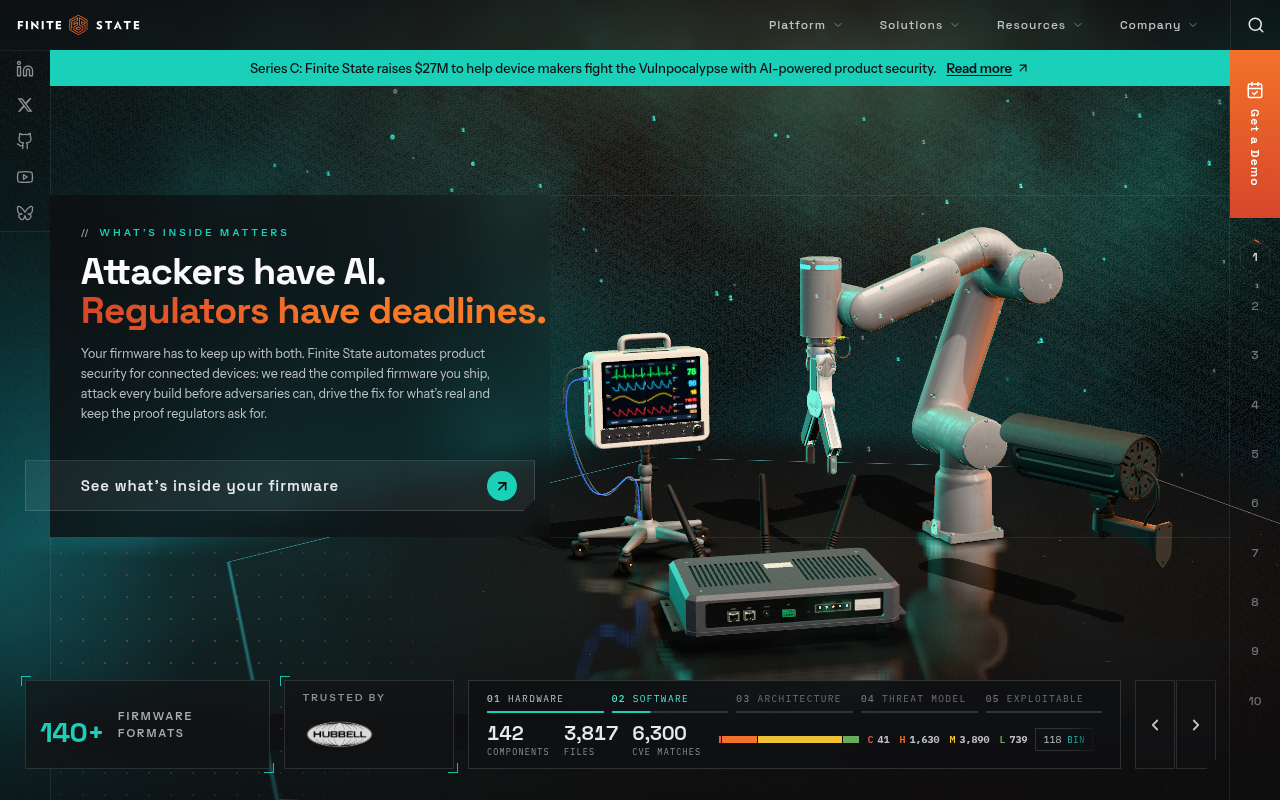
Finite State analyzes firmware, binaries, and software inventories to help device manufacturers manage vulnerabilities and maintain product-security evidence.
Best for
- Medical-device manufacturers managing third-party software and firmware risk
- Product-security teams maintaining inventories and vulnerability evidence across versions
Not ideal for
- Hospitals seeking a managed IT-security provider
- Teams expecting a scanner output to constitute regulatory approval
Bottom line
Finite State is a strong candidate for medical-device teams that need visibility into shipped software and a continuing vulnerability-management process. Its value is greatest when engineering and security teams use the results to prioritize fixes and maintain evidence across device versions.
Score breakdown
Weights: Outcomes 35% · Product 30% · Implementation 20% · Pricing clarity 15%.
Manufacturers use Finite State to understand the software inside connected products and track how vulnerabilities affect particular releases. MedCrypt is a relevant medical-device product-security alternative where the buying job includes software bills of materials (SBOMs), vulnerability analysis, and regulatory evidence. The scope should be matched carefully because product portfolios can include different security functions.
This is specialized enterprise product-security software, with engineering work as well as license cost. It is not a generic managed security service for a hospital’s users and laptops. The useful cost comparison includes supported artifacts, device variants, supplier participation, triage effort, and the evidence the team must maintain after a product ships.
- Product-security decision value (7.5): Build-level analysis supports vulnerability decisions, while evidence quality depends on artifacts and expert review.
- Analysis and evidence workflows (8.3): Binary analysis, SBOM management, reachability, and evidence workflows address connected-device security.
- Engineering implementation (6.8): Teams must connect builds, supplier inputs, ownership, and remediation processes.
- Pricing clarity (5.7): The product pages direct buyers to a demonstration without public license rates.
Finding Risk in What Ships
Finite State combines binary and firmware analysis with source-code and supplier inputs. The platform builds versioned inventories and SBOMs, correlates components with vulnerability information, and uses reachability and context to help prioritize investigation. Binary analysis is particularly relevant when a supplier does not provide complete source code.
A detected component or vulnerability still needs interpretation. Engineering teams have to establish whether the finding applies to the device, how an attacker could reach it, and whether a fix or compensating control is appropriate. The platform supports this work; it does not remove the need for product knowledge and a documented security decision.
Medical-Device Evidence Across the Lifecycle
The medical-device offer describes SBOM and Vulnerability Exploitability eXchange (VEX) workflows, traceability, verification evidence, and postmarket monitoring. VEX records a product team’s assessment of whether a vulnerability affects its product. Keeping these artifacts connected to builds and variants helps teams respond when a new vulnerability is disclosed.
Regulatory submission support is a workflow benefit, not a guarantee that a device meets every requirement or receives clearance. A demonstration should connect representative firmware and supplier inputs to an affected-build decision and its evidence. Medical-device teams also need a plan for remediation ownership, release approval, and customer communication.
Product and service details: finitestate.io, finitestate.io.
Company scale
HIR estimates annual revenue below $100 million from Finite State’s specialist product footprint and growth-stage financing, including the $20 million growth round announced in March 2024. Scale source
What People Say
What people like
"We can inspect third-party firmware even when we do not have all the source code."
"Tracking findings by build helps us identify which device versions need attention."
What people don't like
"Our engineers still have to decide whether a finding affects the device and how to fix it."
Where customer reviews couldn't be found, our analysts attempted to give a voice to buyer sentiment, drawing on real information from review sites, forums and product documentation.
Based on: Product or service details, Product or service details.
The comparison is limited to medical-device product-security and vulnerability-management work. A proposal should distinguish SBOM and software analysis from encryption or other security components.
Competitor landscape
| Vendor | Overall | Ease of implementation |
|---|---|---|
| Finite State | 7.3 | 6.8 |
| MedCrypt | 7.1 | 6.9 |
| Cybellum | 7.3 | 6.9 |
Pricing
| Item | Detail |
|---|---|
| License | Custom enterprise pricing; request a quote for the intended product portfolio. |
| Scope | Confirm artifacts, product lines, build frequency, users, integrations, and monitoring. |
| Implementation | Budget for build connections, supplier inputs, validation, and remediation ownership. |
| Evidence | Confirm supported SBOM and VEX formats, exports, retention, and submission workflows. |
Leadership

Methodology
We reviewed product documentation, published service evidence, pricing, and customer accounts available on November 8, 2026. Scores are editorial assessments on a ten-point scale. The overall score weights outcomes and workflow value at 35%, product at 30%, implementation at 20%, and pricing clarity at 15%. Company-website testimonials are vendor-selected accounts.
Existing peer scores are carried from the linked HIR reviews.
Sources
- Healthcare Industry Reviews analysis of the product, service, and pricing sources below, conducted November 2026.
- finitestate.io · industry/medical devices
- finitestate.io · about
- finitestate.io · news/finite state raises 20 million growth round