Hazel Health
School-connected virtual mental and physical healthcare

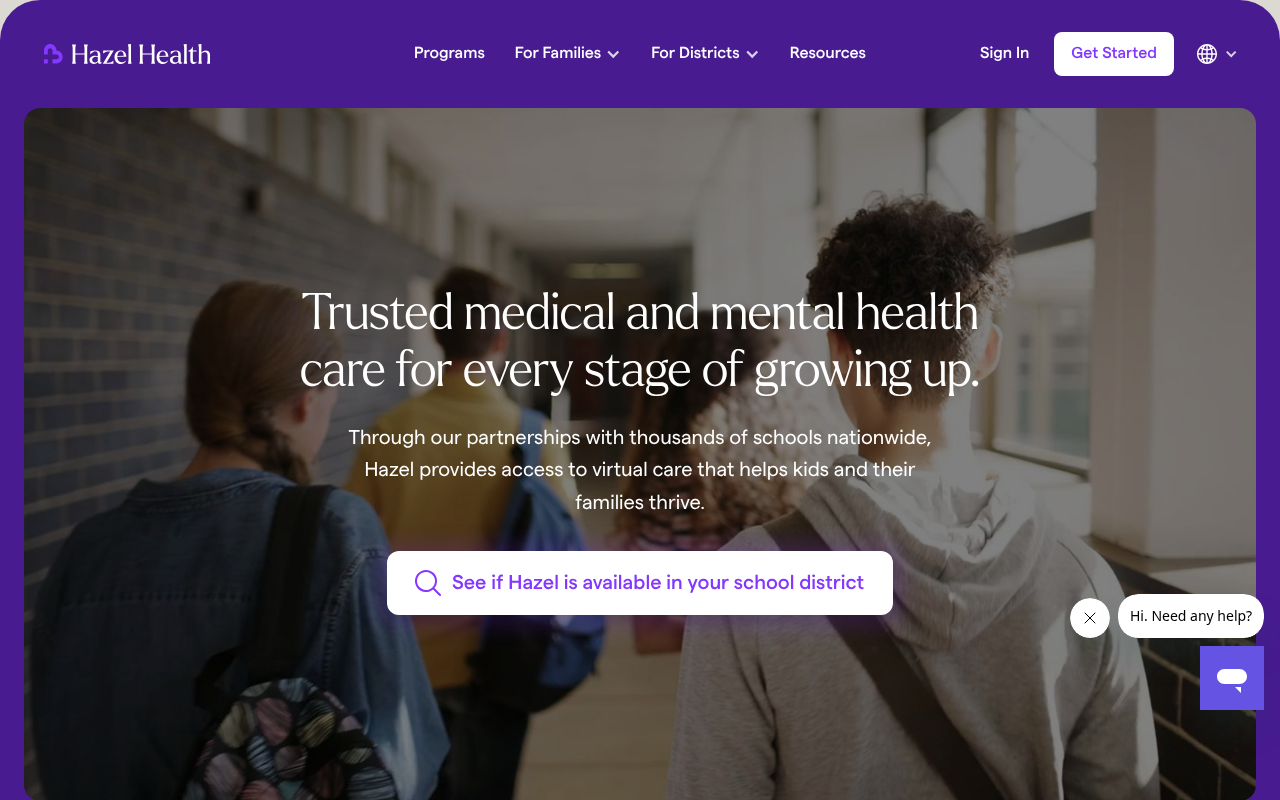
Hazel Health provides licensed virtual mental and physical healthcare for K-12 students through school-district partnerships, at school or at home.
Best for
- Districts seeking a contracted student teletherapy service
- Families in participating districts seeking school-connected care
Not ideal for
- Families outside a participating district or service area
- Students who need emergency care or specialized services beyond the program
Bottom line
Hazel Health is a useful option for participating districts seeking additional student mental healthcare, especially when physical telehealth is also part of the program. It works best as coordinated clinical capacity alongside the school and community care team.
Score breakdown
Weights: Outcomes 35% · Product 30% · Implementation 20% · Pricing clarity 15%.
Hazel Health serves school districts that need additional clinical capacity for students, and families who want a licensed provider connected to their child’s school. Daybreak Health is a direct comparison for district-sponsored virtual youth mental health. Hazel also provides physical healthcare, so a district buying both services is considering a broader program.
For families, Hazel’s stated model removes visit charges through district partnerships and insurance billing. For districts, this is a contracted clinical service with ongoing implementation and referral work, not a low-cost wellness app. The FAQ’s main pricing answer says families will not receive a bill, while a separate insurance answer refers to possible cost sharing. That inconsistency warrants a written explanation for the specific district.
- Outcomes and workflow value (7.8): Published clinical and district evidence supports access and symptom-improvement potential, without proving the same result for every student.
- Product and service depth (8.0): Licensed mental and physical care provide broader service scope than a therapy-only offering.
- Ease of implementation (7.3): District participation, consent, referrals, and state licensure determine access.
- Pricing clarity (7.4): The FAQ describes a no-cost-to-family model, but contains inconsistent insurance cost-sharing language that needs clarification.
What Students Receive
Students can receive scheduled mental health visits with licensed clinicians and virtual physical care for common pediatric concerns. School staff, guardians, and Hazel physical health providers can refer students for therapy. The program is intended to add capacity alongside school counselors and community providers.
Care can take place at home or at school, subject to the available district program. Guardian consent and state licensure rules apply. Students traveling out of state cannot assume they can continue the same virtual visit, and Hazel says it does not duplicate therapy already being delivered elsewhere.
Clinical Evidence and Service Boundaries
The homepage links symptom improvement to a Clemson University study and attendance improvements to a district case study. These are useful signals that a school-connected clinical service can help. They should be read in the context of the students and programs studied, without assuming that every referred student will complete care or improve by the same amount.
Hazel’s FAQ describes regular weekday service hours and says emergency and crisis services require other resources. Students needing a higher level of care or specialized treatment may need a community referral. Prescriptions or external referrals can also create separate family expenses.
Leadership Transition and Continuity
Behavioral Health Business reported in June 2026 that Alexandrea “Alli” Fair would become CEO effective June 29, succeeding Iyah Romm. Romm had succeeded Josh Golomb. The report also described layoffs and an unsuccessful sale process, which matter to districts assessing staffing stability and contract continuity.
Those corporate developments do not establish that care has stopped. Hazel’s current website continues to describe licensed services, enrollment, and school partnerships. A district’s practical questions concern clinician continuity, referral handling, and arrangements for students who need care after a contract changes.
Product and service details: hazel.co, hazel.co.
Company scale
Similarweb’s September 2026 company profile estimates Hazel Health’s annual revenue at $15 million to $25 million. Scale source
What People Say
What people like
"It is easier to get my child help when the school can connect us with a licensed therapist."
"Having medical visits and therapy through the same school partnership would be useful for our family."
What people don't like
"We cannot use this unless our district participates, and it is not emergency care."
Where customer reviews couldn't be found, our analysts attempted to give a voice to buyer sentiment, drawing on real information from review sites, forums and product documentation.
Based on: Product or service details, Product or service details.
Competitor landscape
| Vendor | Overall | Ease of implementation |
|---|---|---|
| Hazel Health | 7.7 | 7.3 |
| Daybreak Health | 7.3 | 7.6 |
| Cartwheel | 7.6 | 7.4 |
Pricing
| Item | Detail |
|---|---|
| Family visits | The main FAQ answer says no co-pay, deductible, or other family charge for Hazel services, including for uninsured students. |
| Insurance ambiguity | Another FAQ answer mentions possible insurance cost sharing. Confirm the applicable district arrangement in writing. |
| Other care | Pharmacy prescriptions and outside referrals can carry separate out-of-pocket expenses. |
| District contract | Commercial terms depend on the partnership; a public district rate is not provided. |
Recent news
- June 2026: Behavioral Health Business reported Alli Fair’s appointment as CEO, effective June 29, following layoffs and an unsuccessful sale process.
Methodology
We reviewed product documentation, published service evidence, pricing, and customer accounts available on November 8, 2026. Scores are editorial assessments on a ten-point scale. The overall score weights outcomes and workflow value at 35%, product at 30%, implementation at 20%, and pricing clarity at 15%. Company-website testimonials are vendor-selected accounts.
Existing peer scores are carried from the linked HIR reviews.
Sources
- Healthcare Industry Reviews analysis of the product, service, and pricing sources below, conducted November 2026.
- hazel.co ·
- hazel.co · faq
- similarweb.com · company/hazel.co
- hazel.co · programs/mental health
- bhbusiness.com · 2026/06/18/hazel health names new ceo amid turbulent period