Labor and Delivery Unit Closure Statistics: 2026 Report
Published
Our analysts brought together three national counts of hospital labor and delivery closures: the University of Minnesota Rural Health Research Center's hospital-level data on 5,019 US hospitals from 2010 to 2024, the Center for Healthcare Quality and Payment Reform's state-by-state tracker of rural closures since 2020, and March of Dimes's list of 96 closures reported from January 2024 to May 2026. Together they show how many hospitals have stopped delivering babies, where the losses are concentrated, and which rural units are most likely to close next as of Q4 2026.
Key Findings
- 144 rural hospitals stopped delivering babies from the end of 2020 through October 2026, 14% of the nation's rural labor and delivery units, and 4 more have announced closures by early 2027.
- 718 US hospitals lost obstetric services from 2010 to 2024, 14.3% of all short-term acute care hospitals, including 67 in the most recent year of data.
- 57.5% of rural hospitals and 43.6% of urban hospitals had no obstetric services in 2024, up from 41.6% and 30.2% in 2010.
- Maine has closed 42% of its rural labor and delivery units since 2020, the highest share of any state, followed by West Virginia at 40% and Indiana at 36%.
- 90 rural hospitals that still deliver babies, 10% of the total, lost money in each of the two most recent years, including 14 in Texas.
When a hospital stops delivering babies, pregnant women in that town have to plan their labor around a drive to the next hospital that still has a maternity unit, and for many rural families that drive is longer than half an hour. Hospitals close these units for three main reasons: fewer births; trouble keeping obstetricians, nurses, and anesthesia staff available around the clock; and payments that do not cover the cost of keeping a unit open. Reporters and policy staff often quote different national totals for these closures, because the main trackers count different hospitals over different years. We wanted one place that shows each count and what it covers.
Our analysts read the University of Minnesota Rural Health Research Center's September 2026 overview, which follows every US short-term acute care hospital from 2010 to 2024 and reports national, rural, urban, and state results. We copied the Center for Healthcare Quality and Payment Reform's state table of rural labor and delivery closures, remaining units, drive times, and units at financial risk, which was current as of October 2026. We added March of Dimes's 2026 maternity care deserts report, which tracked 96 publicly reported closures and the reasons hospitals gave for them. We then lined the three sources up by state and by period.
In the following sections, we compare the three national closure counts, show how the share of hospitals without obstetric services changed in rural and urban areas, rank states by rural closures and by long-term losses, look at why hospitals say they close these units and who is affected, and count the rural units at risk of closing next.
How Many Hospitals Have Stopped Delivering Babies
National closure totals differ by hundreds depending on which hospitals and which years a tracker covers, so we set the three main counts side by side with their scope before looking at the year-by-year pattern for rural hospitals.
| Source | Hospitals covered | Period | Hospitals that stopped delivering babies |
|---|---|---|---|
| University of Minnesota Rural Health Research Center | All US short-term acute care hospitals, rural and urban | 2010 to 2024 | 718 |
| University of Minnesota Rural Health Research Center | All US short-term acute care hospitals, rural and urban | 2023 to 2024 | 67 |
| Center for Healthcare Quality and Payment Reform | Rural hospitals | End of 2020 to October 2026 | 144 |
| Center for Healthcare Quality and Payment Reform | Rural hospitals, closures announced but not yet in effect | Late 2026 to early 2027 | 4 |
| March of Dimes | Publicly reported closures, rural and urban | January 1, 2024 to May 1, 2026 | 96 |
Source: Healthcare Industry Reviews analysis of University of Minnesota Rural Health Research Center (September 2026), Center for Healthcare Quality and Payment Reform (October 2026), and March of Dimes (2026) data.
| Year | Closed | Announced, not yet closed |
|---|---|---|
| 2021 | 13 | 0 |
| 2022 | 24 | 0 |
| 2023 | 37 | 0 |
| 2024 | 25 | 0 |
| 2025 | 30 | 0 |
| 2026 | 15 | 2 |
| 2027 | 0 | 2 |
| Total | 144 | 4 |
Source: Center for Healthcare Quality and Payment Reform, Stopping the Loss of Rural Maternity Care, data current as of October 2026. Yearly values read from the center's chart of closures by year.
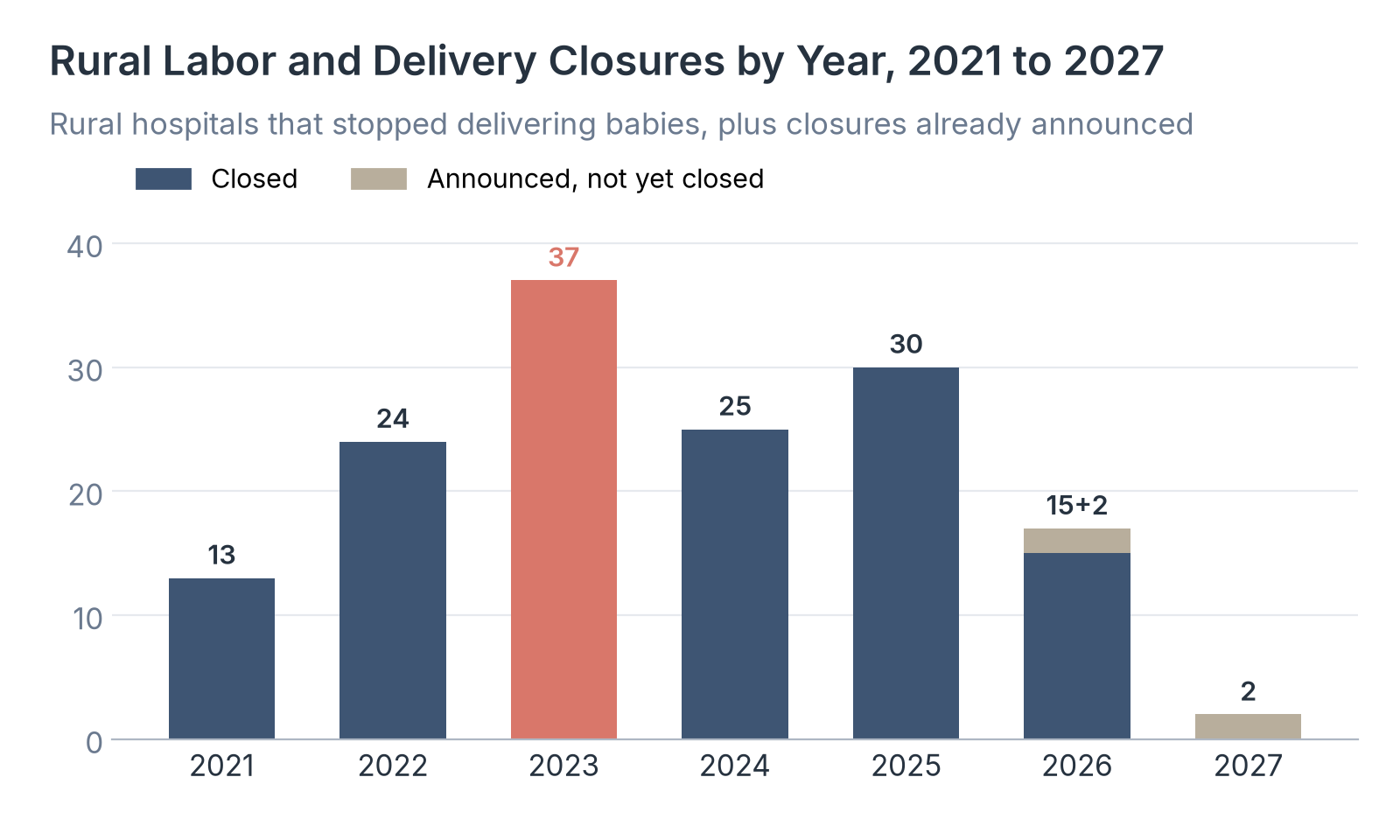
Source: Healthcare Industry Reviews analysis of Center for Healthcare Quality and Payment Reform data, October 2026.
Key Findings
- Rural closures peaked at 37 in 2023 and ran at 24 to 30 a year in 2022, 2024, and 2025. The 144 closures since the end of 2020 average a little over two a month.
- The University of Minnesota count of 718 is the widest, because it covers urban as well as rural hospitals over 15 years and includes 145 hospitals that closed entirely. Of the 67 losses between 2023 and 2024, 42 were at urban hospitals, so urban hospitals made up most of the latest losses.
- The March of Dimes count of 96 relies on news reports and hospital announcements, because national hospital data are released with a lag; the University of Minnesota data end in 2024. For the most recent months it is the most current signal, and its authors note that it may miss some closures.
Share of Rural and Urban Hospitals Without Obstetric Services
Counting closures shows how many units were lost, but a family planning a birth cares more about how many local hospitals still offer obstetric care. The University of Minnesota data let us compare that share in 2010 and 2024 for rural and urban hospitals.
| Hospital location | Hospitals open at any point, 2010 to 2024 | Never had obstetric services | Lost obstetric services, 2010 to 2024 | Without obstetric services, 2010 | Without obstetric services, 2024 |
|---|---|---|---|---|---|
| Rural | 1,971 | 41.5% | 16.0% | 41.6% | 57.5% |
| Urban | 3,048 | 30.4% | 13.2% | 30.2% | 43.6% |
| All hospitals | 5,019 | 34.8% | 14.3% | 34.8% | 49.1% |
Source: University of Minnesota Rural Health Research Center, Annual Overview of Hospital-Level Changes in Obstetric Services Availability, 2010-2024, September 2026.
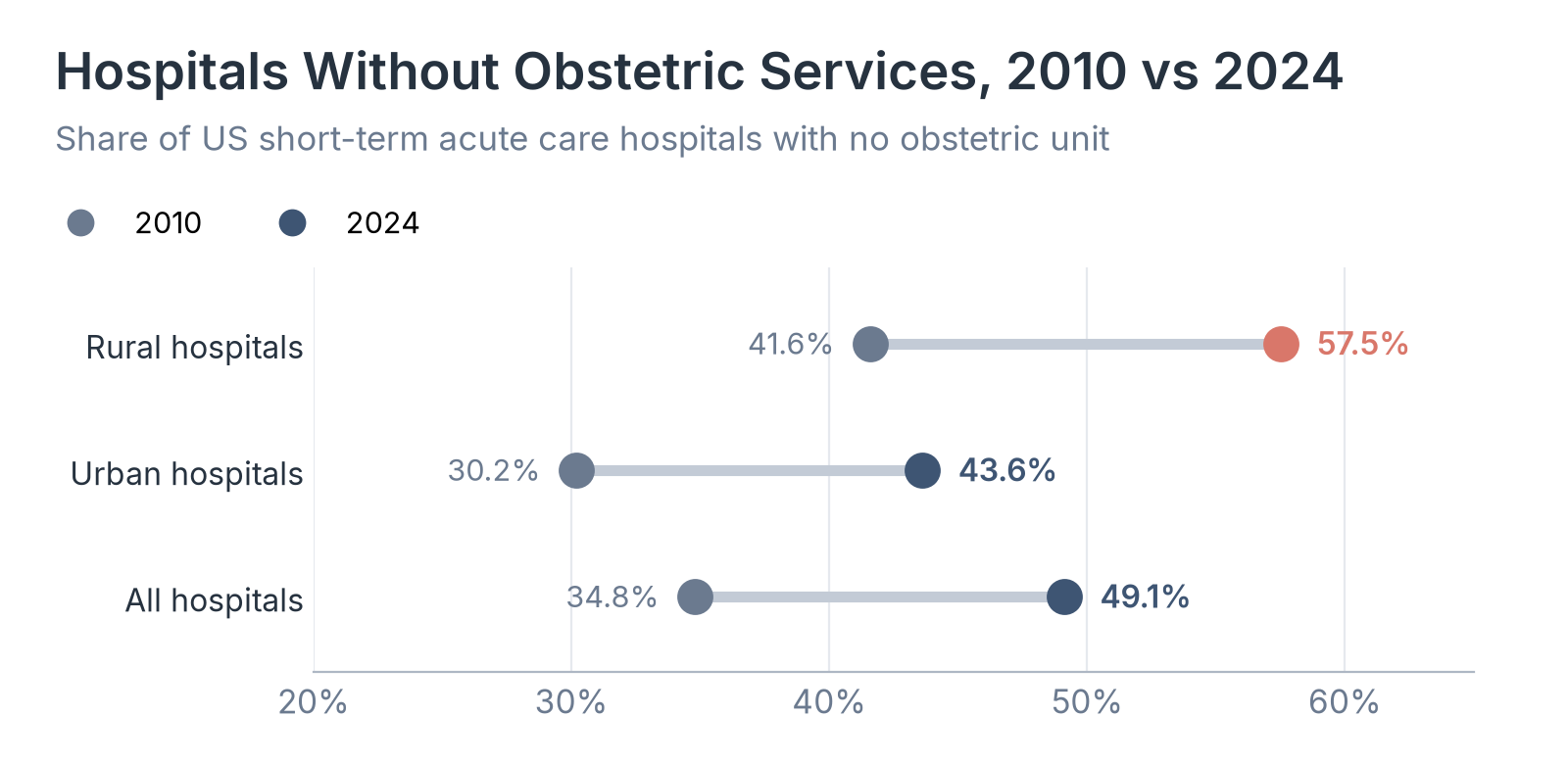
Source: Healthcare Industry Reviews analysis of University of Minnesota Rural Health Research Center data, September 2026.
Key Findings
- The share of rural hospitals without obstetric services rose 15.9 points from 2010 to 2024, and the urban share rose 13.4 points. Rural hospitals made up 39.3% of hospitals in the study but 43.9% of the 718 losses.
- In 2010, more than half of rural hospitals had no obstetric services in 12 states. By 2024 that was true in 31 states, with Florida at 90.9% and North Dakota at 80.6%.
- About 36,000 babies were born in 2023 at hospitals that ended obstetric services the next year, close to 7,000 of them at rural hospitals. Only 6 hospitals added obstetric services between 2023 and 2024, against 67 that lost them.
States That Lost the Most Rural Labor and Delivery Units Since 2020
Closures since 2020 are spread across most states, though a handful have lost a much larger share of their rural maternity units than the rest. We ranked states by that share and added how many rural hospitals still deliver babies, how far rural patients drive to reach one, and the University of Minnesota's longer-term loss rate for each state.
| State | Rural units closed since 2020 | Share of rural units closed | Rural hospitals still delivering babies | Share of rural hospitals with labor and delivery in 2027 | Median drive to labor and delivery from rural hospitals without it (minutes) | Share of all hospitals that lost obstetric services, 2010 to 2024 |
|---|---|---|---|---|---|---|
| Maine | 7 | 42% | 11 | 46% | 41 | 21.6% |
| West Virginia | 4 | 40% | 6 | 18% | 43 | 20.0% |
| Indiana | 13 | 36% | 24 | 44% | 30 | 16.9% |
| Arkansas | 6 | 27% | 16 | 31% | 39 | 13.9% |
| Connecticut | 1 | 25% | 3 | 75% | 31 | 20.0% |
| Virginia | 3 | 23% | 9 | 27% | 42 | 12.4% |
| Ohio | 9 | 22% | 33 | 45% | 30 | 20.2% |
| Pennsylvania | 5 | 22% | 19 | 37% | 38 | 21.4% |
| Wyoming | 4 | 22% | 14 | 52% | 63 | 10.0% |
| Illinois | 5 | 20% | 20 | 25% | 32 | 18.7% |
| Colorado | 4 | 19% | 17 | 40% | 44 | 10.8% |
| New York | 4 | 18% | 23 | 43% | 38 | 11.8% |
| California | 5 | 17% | 25 | 42% | 49 | 17.5% |
| Idaho | 3 | 17% | 15 | 52% | 39 | 17.8% |
| South Carolina | 2 | 17% | 10 | 45% | 39 | 22.1% |
| United States | 144 | 14% | 928 | 40% | 37 | 14.3% |
Source: Healthcare Industry Reviews analysis of Center for Healthcare Quality and Payment Reform (October 2026) and University of Minnesota Rural Health Research Center (September 2026) state tables.
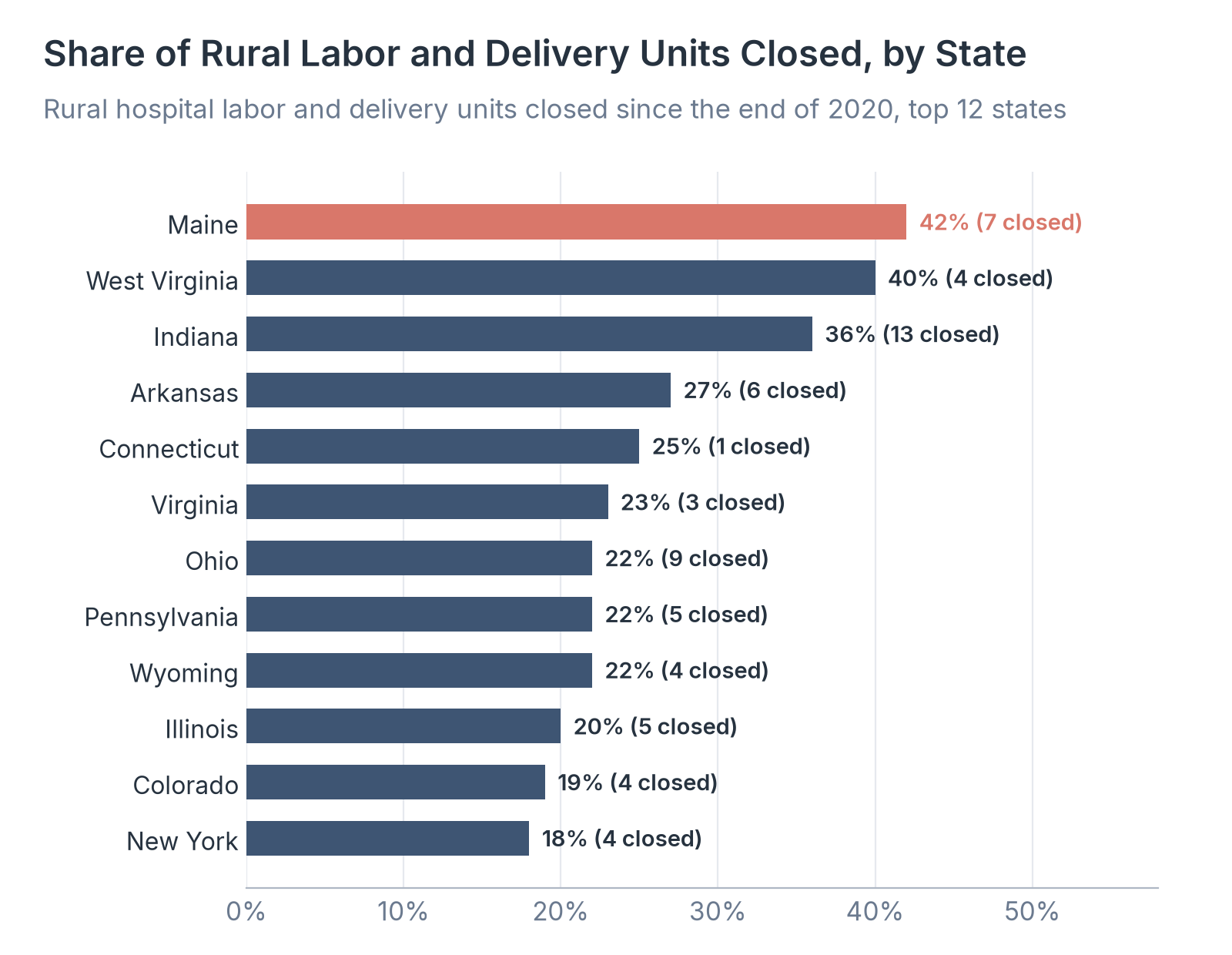
Source: Healthcare Industry Reviews analysis of Center for Healthcare Quality and Payment Reform data, October 2026.
Key Findings
- Ten states have closed at least 20% of their rural labor and delivery units since 2020, and five of them, Maine, West Virginia, Indiana, Arkansas, and Connecticut, have closed a quarter or more. Indiana closed the most units of any state, 13.
- West Virginia has only 6 rural hospitals left that deliver babies, 18% of its rural hospitals, and the median drive from a rural hospital without a unit to one with a unit is 43 minutes. In Wyoming, New Mexico, and North Dakota that median drive is 63 minutes.
- Nationally, 928 rural hospitals expect to still deliver babies in 2027, 40% of all rural hospitals. In states with few units left, such as West Virginia, March of Dimes found that a single closure lengthened drive times across several surrounding counties.
Long-Term Obstetric Service Losses by State, 2010 to 2024
The rural tracker covers only recent years and only rural hospitals, so we also looked at the University of Minnesota's 15-year count for every hospital in each state. It shows which states lost the largest share of obstetric units over 15 years, and which ones lost the most in the latest year of data.
| State | Hospitals open at any point, 2010 to 2024 | Never had obstetric services | Lost obstetric services, 2010 to 2024 | Lost 2010 to 2023 | Lost 2023 to 2024 |
|---|---|---|---|---|---|
| District of Columbia | 8 | 12.5% | 25.0% | 25.0% | 0.0% |
| New Hampshire | 26 | 19.2% | 23.1% | 23.1% | 0.0% |
| Iowa | 120 | 32.5% | 22.5% | 22.5% | 0.0% |
| Minnesota | 131 | 22.1% | 22.1% | 20.6% | 1.5% |
| South Carolina | 68 | 23.5% | 22.1% | 22.1% | 0.0% |
| Maine | 37 | 21.6% | 21.6% | 18.9% | 2.7% |
| Pennsylvania | 173 | 34.1% | 21.4% | 19.1% | 2.3% |
| Wisconsin | 132 | 19.7% | 21.2% | 18.2% | 3.0% |
| Ohio | 173 | 30.6% | 20.2% | 17.9% | 2.3% |
| Connecticut | 30 | 3.3% | 20.0% | 20.0% | 0.0% |
| United States | 5,019 | 34.8% | 14.3% | 13.0% | 1.3% |
Source: University of Minnesota Rural Health Research Center, Annual Overview of Hospital-Level Changes in Obstetric Services Availability, 2010-2024, September 2026.
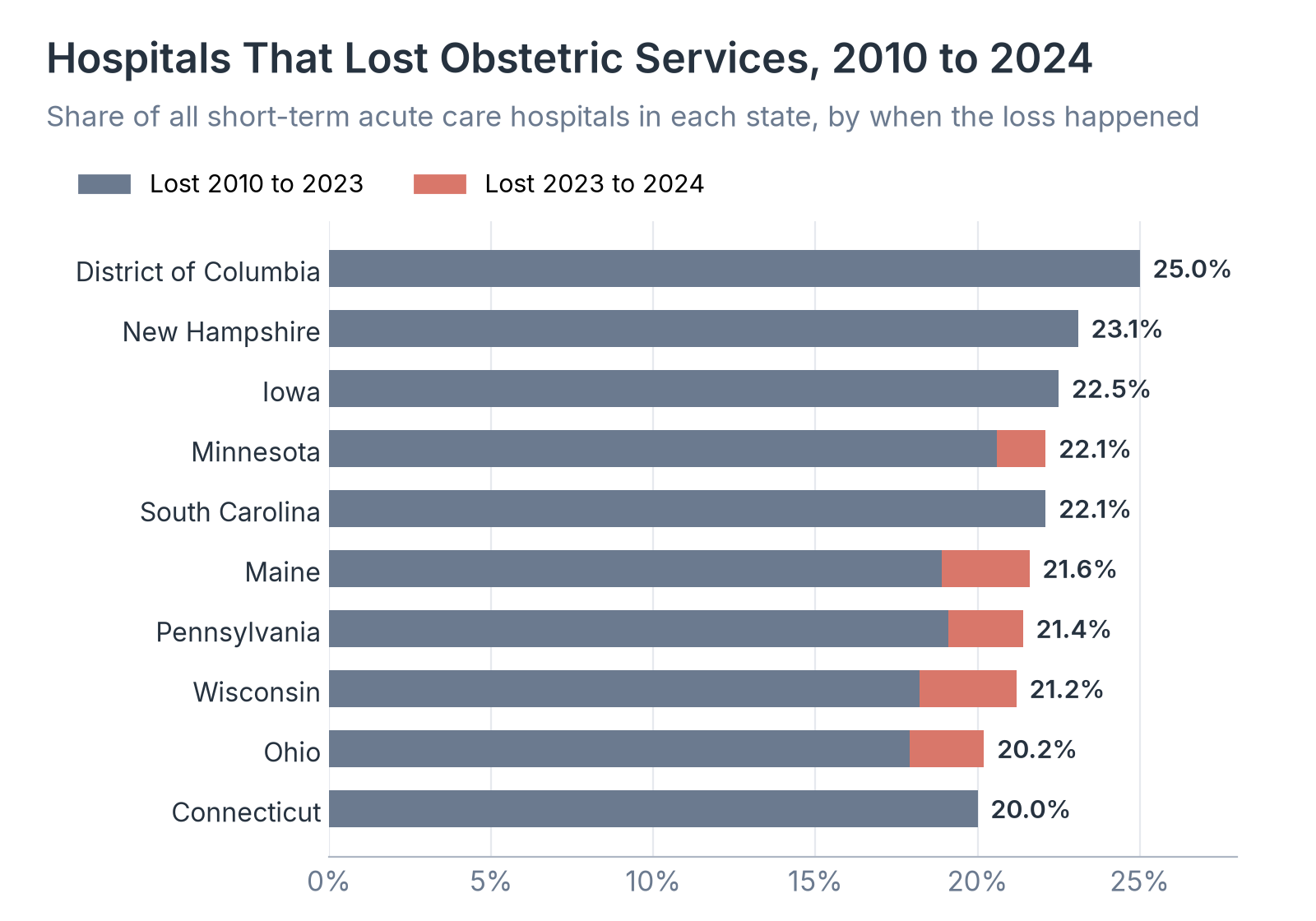
Source: Healthcare Industry Reviews analysis of University of Minnesota Rural Health Research Center data, September 2026.
Key Findings
- In eight states and the District of Columbia, more than 20% of hospitals lost obstetric services between 2010 and 2024. Pennsylvania and Ohio, the largest hospital markets in that group with 173 hospitals each, lost obstetric services at 21.4% and 20.2% of them.
- The latest losses were concentrated elsewhere: 4.8% of Indiana's hospitals lost obstetric services between 2023 and 2024, followed by Idaho at 4.4%, Alabama at 4.0%, Arkansas at 3.8%, and Wisconsin at 3.0%. Twenty-two states and the District of Columbia had no losses that year.
- Delaware was the only state where no hospital lost obstetric services over the 15 years, and Utah lost one of 47. They were also the only two states where the share of hospitals without obstetric services fell from 2010 to 2024.
Why Hospitals Close Labor and Delivery Units and Who Is Affected
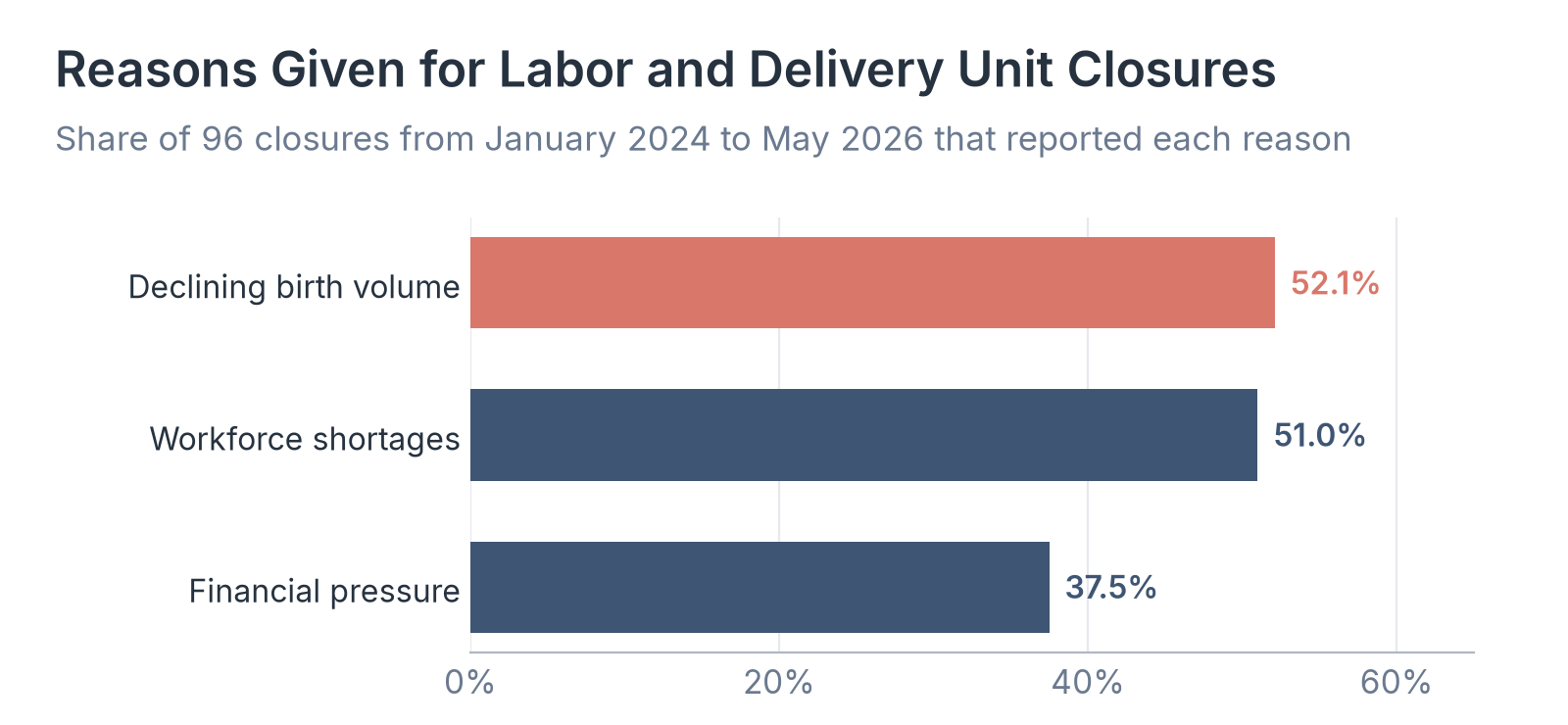
A closure count does not say why a hospital made the decision or how many families feel it. March of Dimes read the announcements and news coverage for each of its 96 recent closures, recorded the reasons given, and measured the change in drive time for the counties around each one.
| Measure | Value |
|---|---|
| Publicly reported closures | 96 |
| States with a closure | 35 |
| Counties with a closure | 91 |
| Share of closures at rural hospitals | 62.5% |
| Share of closures that were the county's only birthing facility | 58.3% |
| Average added drive to the nearest labor and delivery unit | 25.0 minutes |
| Largest added drive | 77 minutes |
| Women of reproductive age living in counties with a recent closure | 9.2 million |
| Births a year in those counties | 465,000 (13% of US live births) |
| Closures citing declining birth volume | 52.1% |
| Closures citing workforce shortages | 51.0% |
| Closures citing financial pressure | 37.5% |
Source: March of Dimes, Nowhere to Go: Maternity Care Deserts Across the U.S. (2026 report), 2026.
Source: Healthcare Industry Reviews analysis of March of Dimes data, 2026.
Key Findings
- Declining birth volume and staffing shortages were each cited in about half of closures. Rural hospitals more often blamed staffing, while urban hospitals more often blamed falling births, according to March of Dimes.
- The largest relative jumps in travel time were in rural states: 12.8% in Wyoming, 10.6% in West Virginia, 7.4% in Maine, and 6.6% in Wisconsin. In Barron and Taylor counties in Wisconsin, drive times to the nearest unit tripled.
- March of Dimes classifies 34.6% of US counties, 1,113 in all, as maternity care deserts with no birthing facility and no obstetric clinician. That share barely moved from 2016 to 2024, because 150 counties became new deserts while 372 counties gained access.
Rural Labor and Delivery Units at Risk of Closing
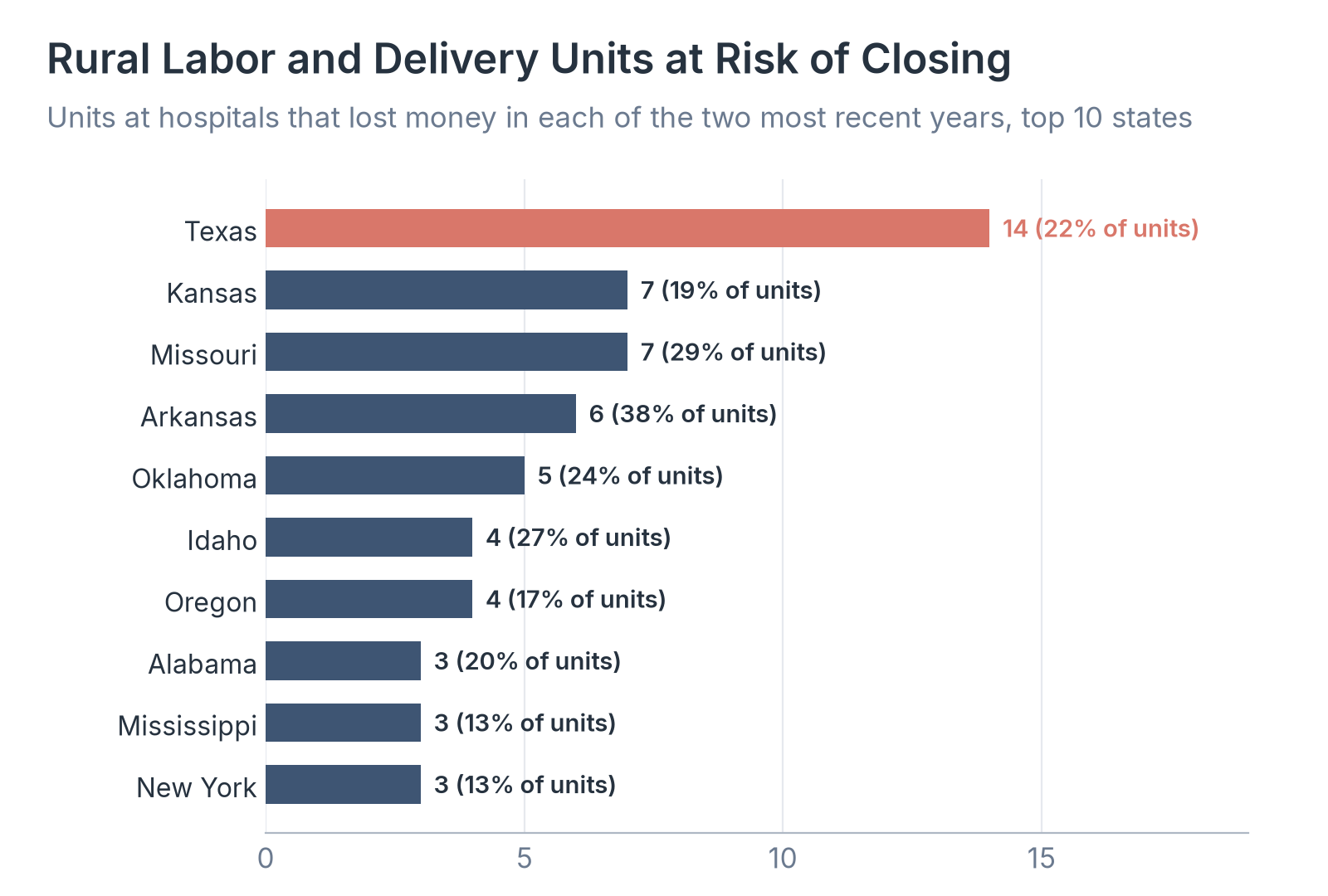
Rural hospitals that lose money on their overall operations could be forced to close labor and delivery services to survive, according to the Center for Healthcare Quality and Payment Reform, since maternity care is costly to staff around the clock. The center flags each rural unit at a hospital with losses on patient services and a negative total margin in both of the two most recent years, and we ranked states by that count.
| State | Units at risk of closing | Share of rural units at risk | Rural hospitals still delivering babies | Median drive from an at-risk unit to the next labor and delivery hospital (minutes) |
|---|---|---|---|---|
| Texas | 14 | 22% | 63 | 40 |
| Kansas | 7 | 19% | 36 | 41 |
| Missouri | 7 | 29% | 24 | 44 |
| Arkansas | 6 | 38% | 16 | 49 |
| Oklahoma | 5 | 24% | 21 | 46 |
| Idaho | 4 | 27% | 15 | 37 |
| Oregon | 4 | 17% | 24 | 51 |
| Alabama | 3 | 20% | 15 | 39 |
| Mississippi | 3 | 13% | 23 | 35 |
| New York | 3 | 13% | 23 | 45 |
| United States | 90 | 10% | 928 | 40 |
Source: Center for Healthcare Quality and Payment Reform, Stopping the Loss of Rural Maternity Care, data current as of October 2026.
Source: Healthcare Industry Reviews analysis of Center for Healthcare Quality and Payment Reform data, October 2026.
Key Findings
- Texas has the most rural units at risk, 14, or 22% of its 63 remaining rural units. Among states with at least five rural units, Arkansas has the highest share at risk, 38%, on top of the 27% of units it has already closed since 2020.
- If an at-risk unit closed, the median drive to the next hospital that delivers babies would be 40 minutes nationally and longer in several states, including 46 minutes in Oklahoma and 44 minutes in Missouri.
- The center notes that more than 40% of rural births are paid for by private insurance, so low commercial payments as well as low Medicaid payments shape whether these units can stay open.
What Labor and Delivery Closure Statistics Mean for Families in 2026
For a pregnant woman in much of rural America, the nearest hospital no longer delivers babies, and the next one is usually at least 30 minutes away and often 50 minutes or more. Rural closures have slowed since their 2023 peak, yet 15 units closed in the first ten months of 2026, 4 more closures are announced, and 90 rural units are at hospitals that lost money in each of the last two years.
Closures are also reaching urban hospitals, which accounted for most of the losses in the latest year of University of Minnesota data and more than a third of the closures March of Dimes tracked. States have started to respond: Maine now requires 120 days' notice before a unit closes, California created a standby perinatal services model for rural hospitals in 2025, and Oregon set aside $25 million in 2026 to support rural maternity care. Many rural towns have also lost their whole hospital, which we count separately in our rural hospital closure statistics report.
So if you cite a labor and delivery closure count, say whether it covers rural hospitals only or all hospitals, and which years, because the most quoted totals range from 96 to 718 for that reason alone.
Data Collection and Methodology
We read the University of Minnesota Rural Health Research Center's Annual Overview of Hospital-Level Changes in Obstetric Services Availability, 2010-2024 (September 2026) on November 2, 2026, and copied its national, rural, urban, and state results, including all 51 rows of its state table. The center identifies obstetric services at every US short-term acute care hospital open at any point from 2010 to 2024 (5,019 hospitals). A hospital counts as having lost obstetric services if it had them in any year from 2010 to 2023 and did not have them in 2024, either because the unit closed or the hospital closed. Rural hospitals are those in counties outside Metropolitan Statistical Areas under the 2023 Office of Management and Budget delineations. Shares without obstetric services in 2024 use every hospital open at any point in the study as the denominator, and 2010 shares use hospitals open in 2010.
We copied the Center for Healthcare Quality and Payment Reform's state table of rural maternity care on November 2, 2026; the center states its data are current as of October 2026. It counts rural hospitals that stopped delivering babies since the end of 2020, closures announced for late 2026 or early 2027, rural hospitals expected to offer labor and delivery in 2027, median drive times, and units at risk of closing. A unit is at risk when its hospital lost money on all patient services and had a negative total margin in both of the two most recent years available. Yearly closure counts come from the center's chart of closures by year, and they add up to its published total of 144. The center notes that two rural Florida hospitals that closed obstetric units were reclassified as urban in 2025 and are not in its rural counts.
March of Dimes figures come from its 2026 report on maternity care deserts. Its closure list covers publicly reported closures from January 1, 2024, to May 1, 2026, drawn from Becker's Hospital Review, the Center for Healthcare Quality and Payment Reform, news reports, and hospital announcements, and may not include every closure. Its county designations combine birthing facility availability, obstetric clinicians, and insurance coverage.
The three sources use different hospital groups, rural definitions, and time periods, so we show their totals side by side and do not add them together. Our state table joins the two state-level sources by state name only. We calculated products, differences, and ratios from the published values.
Sources
- Healthcare Industry Reviews, Labor and Delivery Unit Closure Study: analysis of University of Minnesota Rural Health Research Center hospital-level data on 5,019 US hospitals from 2010 to 2024, the Center for Healthcare Quality and Payment Reform's state table of 144 rural labor and delivery closures since 2020, and March of Dimes's list of 96 closures from January 2024 to May 2026, by period, state, location, and reason, conducted November 2026.
- Interrante J.D., O'Hanlon K., Sheffield E.C., Kozhimannil K.B. University of Minnesota Rural Health Research Center. Annual Overview of Hospital-Level Changes in Obstetric Services Availability, 2010-2024. September 2026.
- Center for Healthcare Quality and Payment Reform. Stopping the Loss of Rural Maternity Care. Data current as of October 2026. Accessed November 2, 2026.
- March of Dimes. Nowhere to Go: Maternity Care Deserts Across the U.S. (2026 report). 2026.