Patient engagement & telehealth · Symptom assessment and clinical triage
Ada Health

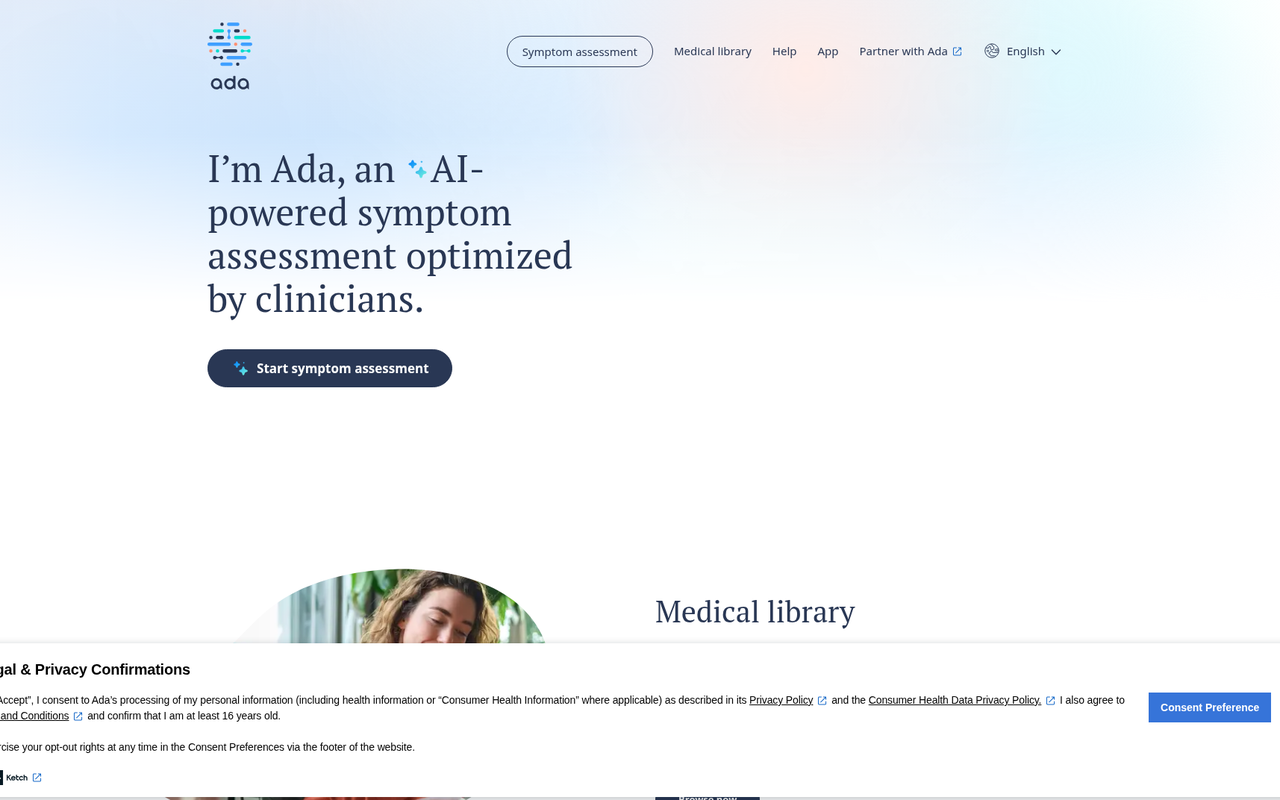
Ada Health develops AI symptom assessment and care-navigation tools that ask patients about symptoms and help healthcare organizations guide them toward an appropriate next step.
Best for
- Providers and health plans adding symptom assessment before a consultation
- Organizations that can connect triage guidance to accessible care services
Not ideal for
- Patients seeking a definitive diagnosis from software alone
- Buyers needing a staffed clinical service with every assessment
Bottom line
Ada Health is a useful candidate for organizations that want structured symptom assessment and a digital route into care. Its clinical engine is only one part of that experience: the organization also needs appropriate escalation and a practical way for the patient to obtain care.
Score breakdown
Weights: Outcomes 35% · Product 30% · Implementation 20% · Pricing clarity 15%.
Ada Health serves consumers through its symptom-assessment experience and enterprise healthcare buyers through care-navigation products. Infermedica is a genuine alternative for symptom interviews and triage. A directory or appointment marketplace without clinical assessment does a different job.
The consumer experience gives people an accessible way to start an assessment. Enterprise deployment is a separate software decision involving integration and service design. Its cost should be compared with other clinical-assessment engines and the internal work required to route patients after an assessment.
- Assessment and navigation evidence (7.6): Published clinical evaluations support the assessment workflow, with limits by setting.
- Clinical assessment engine (8.0): Adaptive questioning and medical knowledge support consumer and enterprise uses.
- Workflow integration (7.0): Organizations must connect recommendations to their actual care services.
- Pricing clarity (6.2): Enterprise prices are not published alongside the product description.
From Symptoms to a Care Recommendation
Ada combines medical expertise and AI to ask follow-up questions about symptoms. For an enterprise buyer, the value is a consistent intake experience and a recommendation about what to do next. Ada also describes Patient Finder, aimed at helping people understand symptoms and reach timely treatment.
The clinical function needs clear boundaries. Possible conditions and suggested next steps are assessment support, and patients may still need examination, testing, or a clinician’s judgment. A provider using Ada should map its recommendations to actual appointment types, urgent services, and local care availability.
Clinical Oversight and Evidence
Ada’s medical team includes doctors and medical knowledge engineers, with co-founder and Chief Medical Officer Claire Novorol overseeing medical quality. The company’s about page cites 2023 post-market research in Portugal and the Netherlands and a 2022 emergency-department pilot.
Its published summary says 94% of participating clinicians considered Ada’s advice safe and appropriate and 83% of its top suggestions matched the physician’s diagnosis. These are results from the cited evaluations, not universal diagnostic accuracy figures. A healthcare organization should examine how well the studied populations and care settings match its intended deployment.
Similarweb estimates Ada Health annual revenue at $25 million to $50 million in its September 2026 company profile. Revenue source
What leaders say
What people like
"I can answer questions about my symptoms before the consultation."
"A structured assessment gives us a clearer starting point for the patient conversation."
What people don't like
"The recommendation only helps if the patient can reach the service it suggests."
Where customer reviews couldn't be found, our analysts attempted to give a voice to buyer sentiment, drawing on real information from review sites, forums and product documentation.
Based on: Ada Health product page, Ada Health supporting source.
Competitor landscape
| Vendor | Overall | Ease of implementation |
|---|---|---|
| Ada Health | 7.4 | 7.0 |
| Infermedica | 7.4 | 7.1 |
Pricing
| Item | Detail |
|---|---|
| Consumer access | The consumer assessment and the enterprise implementation are different offerings. |
| Enterprise software | A commercial quote is needed for the intended use, integration and service volume. |
| Internal work | Care-routing configuration, clinical governance, accessibility, and staff training add work beyond a software license. |
| Comparison | Compare an equivalent clinical-assessment scope and the services available after triage. |
Leadership

Methodology
| Weight | Factor | What it measures |
|---|---|---|
| 35% | Customer outcomes | Whether buyers get measurable operational or clinical-workflow results after go-live |
| 30% | Product | Capability depth, reliability, and fit for the job the category buys |
| 20% | Implementation | How hard it is to stand up, integrate, train, and stabilize |
| 15% | Pricing clarity | Whether a buyer can model total cost without a mystery quote |
| Label | Meaning |
|---|---|
| Highly recommend | Strong outcomes and product with manageable caveats |
| Recommend | Solid fit for the right buyer; know the tradeoffs |
| Conditional | Only with a specific use case or heavy caveats |
| Not recommended | Avoid for most buyers in this category |
Read our full methodology for how we weight scores and assign recommend labels.