Diagnostics & imaging AI · MRI reconstruction and acceleration
AIRS Medical

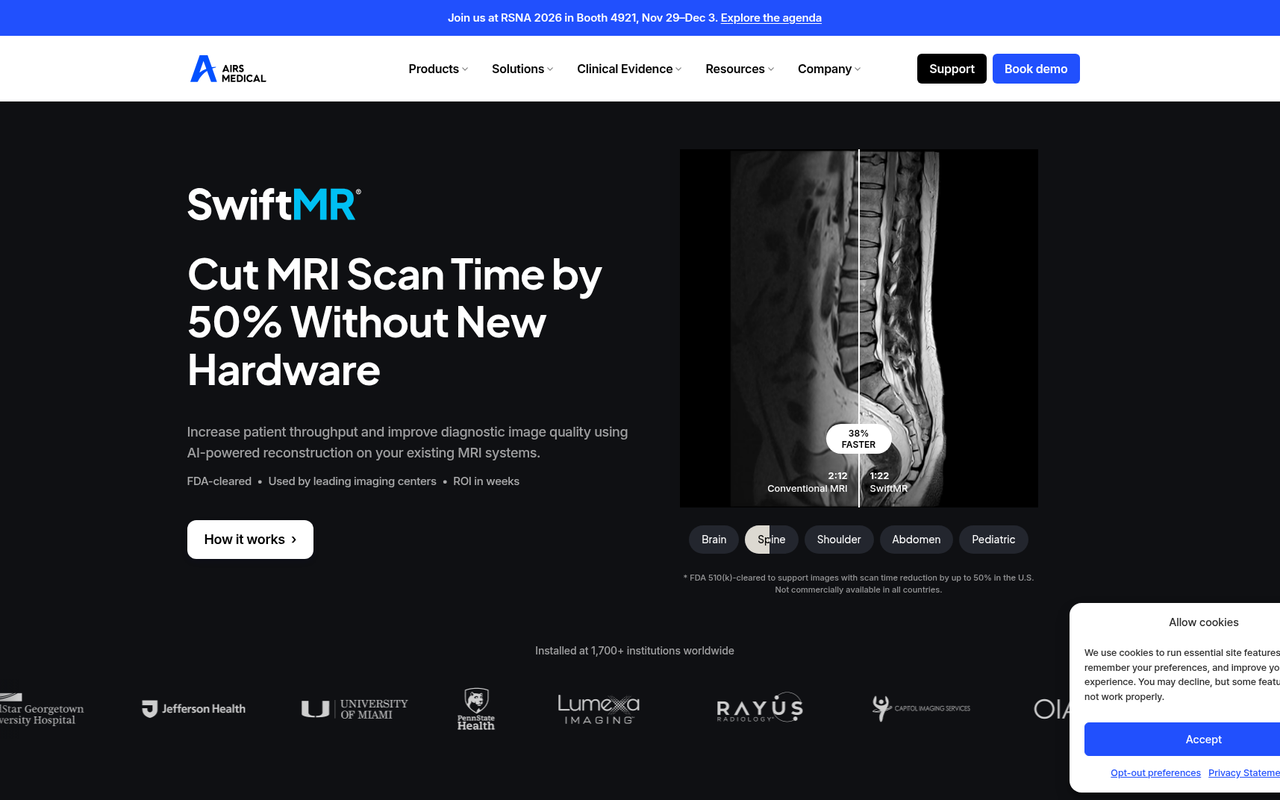
AIRS Medical develops SwiftMR, AI software that reconstructs MRI images to improve image quality or shorten supported scans using an imaging center’s existing scanners.
Best for
- MRI providers trying to increase capacity on existing scanners
- Imaging networks evaluating AI reconstruction across different scanner vendors
Not ideal for
- Buyers seeking acute-image triage or autonomous diagnosis
- Sites expecting time savings without changing protocols or appointment scheduling
Bottom line
AIRS Medical is worth evaluating when MRI scan length constrains an imaging service. SwiftMR can improve the use of existing scanners, provided radiologists accept the output and the service changes its protocols and schedule to use the recovered time.
Score breakdown
Weights: Outcomes 35% · Product 30% · Implementation 20% · Pricing clarity 15%.
AIRS Medical’s principal buyer is an imaging center or health system operating MRI scanners. SwiftMR is an alternative to MRI acceleration software such as Subtle Medical’s MRI products. AI tools that detect urgent findings address a separate workflow and do not replace this reconstruction function.
This is a commercial imaging-software purchase, with value measured against scanner capacity, examination mix, and implementation costs. A faster sequence does not automatically create another billable appointment. Technologist staffing, room turnover, and radiologist acceptance determine how much of the saved time becomes useful capacity.
- Imaging workflow results (7.8): Published studies and customer cases support shorter scans in supported protocols.
- MRI reconstruction capability (8.1): Vendor-neutral reconstruction supports several scanner types and field strengths.
- Scanner and PACS integration (7.2): A gateway and protocol adjustment are required, with local image review.
- Pricing clarity (6.3): A trial is offered, but commercial prices are not published.
What SwiftMR Changes
SwiftMR applies deep learning after acquisition to reduce noise and blur. AIRS says it can be used to improve images at existing acquisition times or preserve diagnostic image quality with shorter supported protocols. Its product page describes U.S. clearance for scan-time reduction of up to 50%; that is a maximum supported claim, not a universal result.
The company says SwiftMR supports scanners from 0.25T to 3.0T, including open and upright systems. Its FAQ reports study mean reductions of 32% to 41% for selected brain, knee, and lumbar spine examinations. Local testing remains important because anatomy, sequences, and image preferences differ.
Implementation and Evidence
Installation involves a gateway computer, network connections to MRI and PACS, protocol selection, and adjustment at the scanner console. AIRS describes two days for installation and training, followed by monitoring. The public product page offers a one-month trial, which gives a site a defined period for radiologist review and operational measurement.
In June 2026 AIRS reported deployment in more than 1,700 institutions across over 40 countries. Its case studies include shorter appointment slots and increased throughput. Those are vendor-published deployments and customer accounts, so their most useful role is to show what a site should measure during a trial: diagnostic acceptability, repeat scans, examination times, and completed appointments.
What leaders say
What people like
"Our staff finally has a work-life balance again. We can see more patients and still leave on time." Kevin Taylor, TaylorMED MRI owner, testimonial published by AIRS Medical
"We can test shorter protocols on our existing MRI scanners."
What people don't like
"Installing the software still means adjusting protocols and getting our radiologists comfortable with the images."
Where customer reviews couldn't be found, our analysts attempted to give a voice to buyer sentiment, drawing on real information from review sites, forums and product documentation.
Based on: AIRS Medical product page, AIRS Medical supporting source.
Competitor landscape
| Vendor | Overall | Ease of implementation |
|---|---|---|
| AIRS Medical | 7.5 | 7.2 |
| Subtle Medical | 7.2 | 6.8 |
Pricing
| Item | Detail |
|---|---|
| Commercial software | Pricing is by agreement; no public subscription amount is supplied on the product page. |
| Trial | One-month trial offered. AIRS says it does not extend demo licenses beyond one month. |
| Implementation | Gateway installation, networking, scanner-console protocol changes, and training. |
| Cost comparison | Compare software and integration cost with usable scanner hours gained for your own examination mix. |
Leadership

Recent news
- June 2026: AIRS Medical announced a strategic growth investment from TA Associates to support international expansion and product development. Financial terms were not disclosed. Source
Methodology
| Weight | Factor | What it measures |
|---|---|---|
| 35% | Customer outcomes | Whether buyers get measurable operational or clinical-workflow results after go-live |
| 30% | Product | Capability depth, reliability, and fit for the job the category buys |
| 20% | Implementation | How hard it is to stand up, integrate, train, and stabilize |
| 15% | Pricing clarity | Whether a buyer can model total cost without a mystery quote |
| Label | Meaning |
|---|---|
| Highly recommend | Strong outcomes and product with manageable caveats |
| Recommend | Solid fit for the right buyer; know the tradeoffs |
| Conditional | Only with a specific use case or heavy caveats |
| Not recommended | Avoid for most buyers in this category |
Read our full methodology for how we weight scores and assign recommend labels.