Patient engagement & telehealth · Cellular monitoring devices
BodyTrace
BodyTrace makes cellular-connected scales and blood pressure monitors that send measurements to remote patient monitoring systems without a patient phone, Wi-Fi connection, or Bluetooth pairing.
Best for
- RPM providers adding connected scales and blood pressure cuffs to an existing clinical platform
- Programs serving people who struggle with phone apps or Bluetooth pairing
Not ideal for
- Practices seeking a fully staffed monitoring service
- Programs without a way to review readings and contact patients
Bottom line
BodyTrace is a useful device supplier for remote monitoring programs that already have clinical software and staff. Its main advantage is straightforward cellular transmission, with fewer patient setup steps. The provider remains responsible for interpreting measurements and acting on them.
Score breakdown
Weights: Outcomes 35% · Product 30% · Implementation 20% · Pricing clarity 15%.
BodyTrace fits remote patient monitoring operators, research teams, and care providers that need readings from patients at home. The main comparison is with Smart Meter and Tenovi: all can supply measurements to a separate monitoring workflow. BodyTrace uses direct cellular connectivity in its devices; Tenovi also offers a cellular gateway for supported Bluetooth devices.
The published scale subscription bundles hardware and connectivity, making the offer easier to understand than a separate hardware purchase and carrier contract. That scale price should not be treated as a current quote for blood pressure devices or an entire clinical monitoring program.
- Measurement delivery and adherence (7.0): Automatic transmission reduces the work of collecting readings; it does not establish a clinical outcome.
- Cellular devices and API (7.5): Direct cellular devices and a simple data interface suit existing monitoring platforms.
- Patient setup and integration (7.5): Patients avoid pairing, while the provider still needs data routing and a response workflow.
- Pricing clarity (6.8): A scale subscription is published, but it does not price the full current device range.
How BodyTrace Is Used
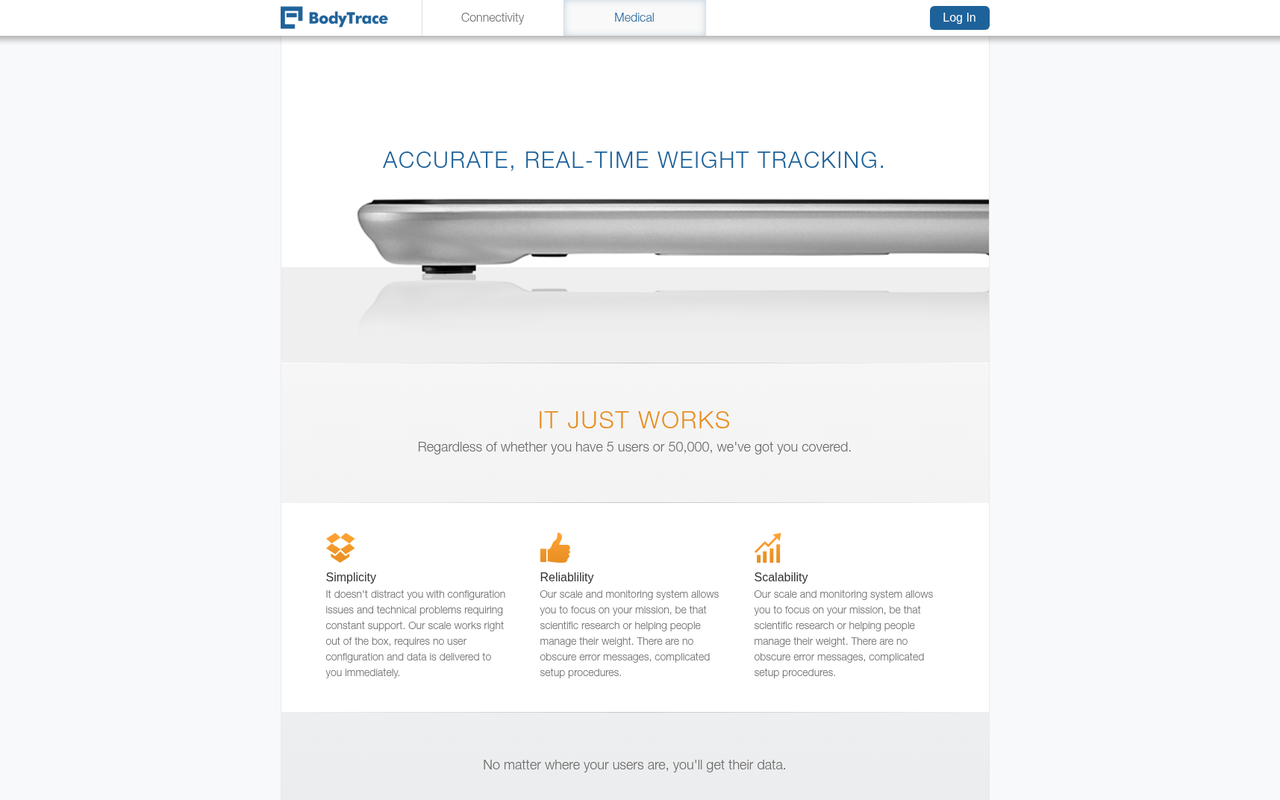
Its medical page describes scales that work without patient configuration and send weight measurements to a web interface or API. This helps when a program needs repeated measurements without asking a patient to enter results manually. The page also offers branding and customization for qualifying orders.
CCN Health documents an integration with BodyTrace weight scales and a BT105 blood pressure monitor. That is useful evidence of the device-to-platform job: the device transmits a reading, while CCN supplies the clinical environment. A device connection alone does not supply clinical escalation, reimbursement documentation, or patient outreach.
Setup and Limitations
Cellular coverage still matters at the patient’s home. Avoiding a phone app removes one source of setup trouble, but it does not remove the need to check whether measurements arrive reliably. A provider also needs a process for assigning the device to the correct patient and handling a replacement.
BodyTrace describes automatic encryption and provisioning for its connectivity infrastructure. Buyers should distinguish those transmission functions from their own obligations for access controls, consent, and clinical recordkeeping. The public medical page provides a useful description of the scale service, with less detail on current commercial terms for its wider medical range.
LeadIQ estimates BodyTrace annual revenue at $1 million to $10 million as of October 2026. Revenue source
What leaders say
What people like
"I can take a reading without pairing the device to my phone."
"We can bring weight readings into our own monitoring system."
What people don't like
"We still need someone to review the readings and follow up with patients."
Where customer reviews couldn't be found, our analysts attempted to give a voice to buyer sentiment, drawing on real information from review sites, forums and product documentation.
Based on: BodyTrace product page, BodyTrace supporting source.
Competitor landscape
| Vendor | Overall | Ease of implementation |
|---|---|---|
| BodyTrace | 7.2 | 7.5 |
| Smart Meter | 7.0 | 7.1 |
| Tenovi | 7.3 | 7.3 |
Pricing
| Item | Detail |
|---|---|
| Published scale subscription | $80 annually, including the scale, cellular connectivity, web monitoring interface, and API, on the undated medical page checked November 8, 2026. |
| Other devices | Blood pressure hardware and current volume terms require a separate quote. |
| Cost drivers | Device mix, replacement policy, connectivity terms and integration work. |
| Scope | The scale subscription is device infrastructure. It does not include a staffed clinical service. |
Methodology
| Weight | Factor | What it measures |
|---|---|---|
| 35% | Customer outcomes | Whether buyers get measurable operational or clinical-workflow results after go-live |
| 30% | Product | Capability depth, reliability, and fit for the job the category buys |
| 20% | Implementation | How hard it is to stand up, integrate, train, and stabilize |
| 15% | Pricing clarity | Whether a buyer can model total cost without a mystery quote |
| Label | Meaning |
|---|---|
| Highly recommend | Strong outcomes and product with manageable caveats |
| Recommend | Solid fit for the right buyer; know the tradeoffs |
| Conditional | Only with a specific use case or heavy caveats |
| Not recommended | Avoid for most buyers in this category |
Read our full methodology for how we weight scores and assign recommend labels.